Seton Hall head coach Kevin Willard on whether he got what he wanted to see:
"The big thing why we went Friday-Sunday was I wanted to see how these guys, get these guys used to short turnarounds, preparation; see how they would focus in because we're going to have that during Thanksgiving, we've got Thursday-Friday-Sunday, so I wanted to make sure these guys understand the quick turnarounds. I thought they came out with good defensive intensity. We got up 24-4. We just need to be a little bit more, in times where we get the lead, we get a little loose with the basketball, we get a little careless on offense. We just need to kind of keep our offensive intensity going a little bit more."
On Myles Powell:
"He's getting it. He still has the jitters a little bit. There's a difference between practice and games, and that's the other thing. A lot of the younger guys got some tonight to get their feet wet a little bit, and he'll continue to find his stroke and find better shots and take better shots. His thing is he's just trying to get the shot off right now. Once he relaxes a little bit, he'll start taking better shots."
On 15-0 run early in the first half:
"I think the biggest thing was we got some easy buckets early, and we got them to take a couple of tough shots. When you can get teams to take tough shots and you can get easy buckets early, it takes a little wind out of the sails of the other team and I think that's something, again: We wanted to come out early and play well defensively, and I think we set a good tone. For the most part, they did what they had to do."
On improvement heading into Iowa:
"We've got a lot to improve on. I think the biggest thing is we've got to make sure, we have to somehow figure out how to create turnovers. We're not creating enough turnovers. That's two teams in a row that haven't turned the ball over. That was something why we got so good defensively last year. I think Isaiah (Whitehead) and Derrick (Gordon)...Madison (Jones) is a much better on-ball defender than both those guys, but he's just much more of a solid player; which I have no problem with, where the difference with Derrick and Isaiah was they knew how to gamble and create steals and get some easy buckets. That's what I'm struggling with now. We've got to find a way to get some easy buckets in transition, because we're not getting a whole lot of easy buckets in transition."
On raising a second Big East championship banner before the game:
"The one at Walsh for me was a little bit more special, just because it was on campus. Here, with the lights out, I thought the video was tremendously well done; but I thought at Walsh, with all the people, as tight as it was and with the history of Walsh...it was great, but it is time to move on and come back to reality."
On Iowa and how they match up with Seton Hall:
"Their length is really impressive. The way Fran (McCaffery) plays, he gets up and down, we're going to have to really be strong on transition defense. I keep forgetting this kid's name, (Peter Jok) I'm sure after the game I won't forget it. He's a heck of a player, he's got the ultimate green light, he's got great range, he scores in all different manners and ranges. It's going to be our first road test since...we haven't played a road game in a while, so it's going to be a great challenge for us to kind of get our feet wet on the road against a very good team."
On his rotation:
"Probably, it should be nine or ten most of the preseason, and maybe hopefully, I could keep it at nine or ten going forward."

Sunday, November 13, 2016


Seton Hall routs CCSU, improves to 2-0

Angel Delgado's 14 points and 16 rebounds helped Seton Hall handle Central Connecticut State Sunday at Prudential Center. Pirates head to Iowa for first road trip of season Thursday. (Photo by Fox Sports)
NEWARK, NJ -- Seton Hall's first encore since an impressive opening-night win against Fairleigh Dickinson proved in many ways to provide more of the same.
For starters, there was a second pregame ceremony to raise a Big East championship banner to the rafters of the Prudential Center, followed by an Angel Delgado double-double. On top of that, four Pirates scored in double figures as the Hall defeated their second Northeast Conference opponent in as many games, cruising to an 82-58 victory over Central Connecticut State Sunday afternoon to move to 2-0 on the year.
"I thought they came out with good defensive intensity," head coach Kevin Willard said on an afternoon where the Pirates led wire-to-wire against CCSU and first-year head coach Donyell Marshall. "We got up 24-4, but when we get the lead, we tend to be a little loose with the basketball. We just need to keep our offensive intensity going a little bit more."
Seton Hall jumped on the accelerator early following matching layups from Delgado and CCSU's Tyson Batiste, going on a 24-2 run over the next 11 minutes to take a 26-4 lead that the youthful Blue Devils (1-1) could not fully overcome.
Khadeen Carrington led The Hall and all scorers for the second consecutive game, recording 18 points in the winning effort. Delgado amassed 14 points and 16 rebounds, while freshman Myles Powell added 13 and Desi Rodriguez contributed 12 of his own. For CCSU, Mustafa Jones' 11 paced the Blue Devils, with Batiste accounting for 10 points.
The Pirates now embark on their first road trip of the season, traveling to Iowa for a Gavitt Games matchup on Thursday before competing in the Advocare Invitational at the end of the month in Orlando.
NOTES: Angel Delgado's double-double was the 25th of his career, coming in his 67th game. Seton Hall is 21-4 when Delgado in those outings. Khadeen Carrington continues to be the Pirates' most efficient shooter on the young season, shooting 68 percent (15-for-22) from the floor and 90 percent (9-of-10) from three-point range. The Pirates continue to rack up points in the paint, as 91 of their 173 markers to date have come in the lane...Seton Hall outscored CCSU 40-30 in that department Sunday afternoon. Walk-ons Michael Dowdy Jr. and Manny Anderson saw their first action of the season in the final minutes; for Anderson, it was the first game of his career. A crowd of 6,354 was on hand to see the Prudential Center opener...Seton Hall's next home game comes December 1 against Columbia and new head coach Jim Engles.
Seton Hall 91, FDU 70: Ray Floriani's Photo Essay
SOUTH ORANGE, NJ - Parking spaces were at a premium, a commodity to be cherished on this evening.
It was Friday, so the issue was not night classes. It was the opening of the 2016-17 seasons. Workouts, practices and exhibitions aside; tonight, it tipped off for real, to go officially in the books.
The meeting was between two New Jersey schools that happened to be champions of their respective conferences: Fairleigh Dickinson, of the Northeast Conference, made the roughly 25-mile trip here to face Big East titlist Seton Hall at historic Walsh Gymnasium.
To little surprise, FDU proved to be a resilient test. Constantly battling back from deficits to make it a one or two-possession game, the Knights refused to fold. In the final analysis, the deceptive 91-70 score in Seton Hall’s favor was a case of the visitors just getting worn down from physical play and having to make successive comebacks.
For Seton Hall coach Kevin Willard, the opener was a challenge from an in-state program determined to bring their ‘A’ game. Willard got a win and found out several good things about his club. Openers at home should provide the former, if you get the latter, consider it a bonus.
For Greg Herenda’s Knights, a gut check of their own, facing a Big East champion on their home floor. This first contest saw the Knights on the short end while providing a prep for the rigors of conference battles. No one enjoys losing, but in this loss, Herenda saw positives to build on as well as others to work on.
In the end, a packed crowd was treated to a game with both teams giving the extra effort. The season is but one day old. Already, both coaches were able to exit Walsh Gymnasium with a good point of reference regarding their respective teams.
All quiet outside a frenzied Walsh Gymnasium:

Ever sharp on the whistle, veteran Ed Corbett served as lead referee:

A winner earlier in the day with his women's program, Tony Bozzella takes in the action alongside his family:

The obligatory pregame press room dining, provided by a local pizzeria:

Perimeter play heating up as FDU's Stephan Jiggetts works against Seton Hall point guard Madison Jones:

Former Fordham and Hofstra head coach Tom Pecora, analyzing the action in the broadcast booth:

Kevin Willard addresses the media after the game:

Saturday, November 12, 2016
Kevin Willard quotebook: FDU postgame
Seton Hall head coach Kevin Willard on Madison Jones' performance:
"Ten assists, one turnover, 31 minutes? I think he passed the first test. We had been starting Myles Powell and Khadeen (Carrington) in the backcourt and Khadeen was really struggling with just the transition, not having another guy back there to help him, and when we moved Madison over last week, he just kind of gave Khadeen a little bit more freedom to be aggressive on offense, which we need him to be. I think Madison fits this group better because he just understands his role. Defensively, he helps us. He's active, gets deflections, and can guard the other team's best player."
On cleaner play after halftime:
"Yeah, first half jitters, a lot. Some of our turnovers were just careless in the first half, and that's the first four or five games, you expect that. I thought the guys did a good job of kind of slowing down the offensive end in the second half, and we also got the ball to the guys who could make plays; Desi, (Rodriguez) Madison and Khadeen, to kind of get guys shots."
On Angel Delgado (22 points, 14 rebounds) and what he expects from him:
"I mean, 22 is nice. He's definitely going to get the ball more, he's got to do better when he has it. Five turnovers is a big issue for me. He's a better passer and he's got to make better decisions when he gets doubled, because he's going to start getting doubled, but yeah. Again, you look at Desi, he's got 12 points, 10 rebounds and five assists, he stepped up his game. They all had to step up their game just a little bit, not tremendously, and I thought they all did a pretty good job of doing what they do very well."
On Michael Nzei and his increased workload:
"It's been great. Mike's been great. They're good, Greg (Herenda, FDU's coach) does a great job. That's a tough opening game. It's not the opening game you want to have, but I wanted to test our guys this year and when you play against three good guards like they have, a power forward when they have (Earl) Potts back, you don't get to use a whole lot. That's why Ish (Sanogo) was out there probably more than he should have. Michael's going to continue to get his minutes up a little bit, they all will. We'll see nine, ten guys in double figures as the season goes forward."
On Delgado's health after an apparent ankle injury in the first half:
"Angel's okay. He sprained his ankle last week in practice, last Friday. Yesterday was his first day back and he re-rolled it, but he's okay. He'll sit out tomorrow and we'll see where he's at, whether he plays on Sunday."
On offensive production:
"This is a funny group, Khadeen played in the Big East tournament and he had 27, 24, and then he didn't play very good against Villanova. He had been playing like this the second half of the season, and all these guys understand and respect what Isaiah (Whitehead) did for them. They really do. If you talk to them, they know it, they'll say it. So with that respect, they're not waiting for it. They just kind of understand the responsibility they have to step up their game. They're not looking forward to it, they're not all trying to do it, they just know as a group that, hey, we just lost a real great player, a high-energy guy in Derrick, (Gordon) and everybody's got to take a step up. I think that's what I like about this group's attitude is that they understand it's not like 'hey, I've got to do it now because Isaiah's not here,' it's like 'we all have to do it because we've got a great player playing a lot of minutes in the NBA."
On Isaiah Whitehead, who attended Friday's game:
"He's up in my office now more than he was before. We went through a very tough decision during the summer, whether he's going, whether he's staying. Me and his mom were trying to get him to go, he was trying to stay. He loves it here. These are his guys. When you win a championship the way we did, you get a bond that lasts forever, you really do. You never forget those moments, and these guys love being around him. They love hearing the NBA stories, and he loves coming back and hearing the stories of what's going on here. We've always been a tight-knit group for the last three years, to be honest with you. It's great having him around, because it's great for the recruits, but also what happens when you get drafted and you play real darn good."
"Ten assists, one turnover, 31 minutes? I think he passed the first test. We had been starting Myles Powell and Khadeen (Carrington) in the backcourt and Khadeen was really struggling with just the transition, not having another guy back there to help him, and when we moved Madison over last week, he just kind of gave Khadeen a little bit more freedom to be aggressive on offense, which we need him to be. I think Madison fits this group better because he just understands his role. Defensively, he helps us. He's active, gets deflections, and can guard the other team's best player."
On cleaner play after halftime:
"Yeah, first half jitters, a lot. Some of our turnovers were just careless in the first half, and that's the first four or five games, you expect that. I thought the guys did a good job of kind of slowing down the offensive end in the second half, and we also got the ball to the guys who could make plays; Desi, (Rodriguez) Madison and Khadeen, to kind of get guys shots."
On Angel Delgado (22 points, 14 rebounds) and what he expects from him:
"I mean, 22 is nice. He's definitely going to get the ball more, he's got to do better when he has it. Five turnovers is a big issue for me. He's a better passer and he's got to make better decisions when he gets doubled, because he's going to start getting doubled, but yeah. Again, you look at Desi, he's got 12 points, 10 rebounds and five assists, he stepped up his game. They all had to step up their game just a little bit, not tremendously, and I thought they all did a pretty good job of doing what they do very well."
On Michael Nzei and his increased workload:
"It's been great. Mike's been great. They're good, Greg (Herenda, FDU's coach) does a great job. That's a tough opening game. It's not the opening game you want to have, but I wanted to test our guys this year and when you play against three good guards like they have, a power forward when they have (Earl) Potts back, you don't get to use a whole lot. That's why Ish (Sanogo) was out there probably more than he should have. Michael's going to continue to get his minutes up a little bit, they all will. We'll see nine, ten guys in double figures as the season goes forward."
On Delgado's health after an apparent ankle injury in the first half:
"Angel's okay. He sprained his ankle last week in practice, last Friday. Yesterday was his first day back and he re-rolled it, but he's okay. He'll sit out tomorrow and we'll see where he's at, whether he plays on Sunday."
On offensive production:
"This is a funny group, Khadeen played in the Big East tournament and he had 27, 24, and then he didn't play very good against Villanova. He had been playing like this the second half of the season, and all these guys understand and respect what Isaiah (Whitehead) did for them. They really do. If you talk to them, they know it, they'll say it. So with that respect, they're not waiting for it. They just kind of understand the responsibility they have to step up their game. They're not looking forward to it, they're not all trying to do it, they just know as a group that, hey, we just lost a real great player, a high-energy guy in Derrick, (Gordon) and everybody's got to take a step up. I think that's what I like about this group's attitude is that they understand it's not like 'hey, I've got to do it now because Isaiah's not here,' it's like 'we all have to do it because we've got a great player playing a lot of minutes in the NBA."
On Isaiah Whitehead, who attended Friday's game:
"He's up in my office now more than he was before. We went through a very tough decision during the summer, whether he's going, whether he's staying. Me and his mom were trying to get him to go, he was trying to stay. He loves it here. These are his guys. When you win a championship the way we did, you get a bond that lasts forever, you really do. You never forget those moments, and these guys love being around him. They love hearing the NBA stories, and he loves coming back and hearing the stories of what's going on here. We've always been a tight-knit group for the last three years, to be honest with you. It's great having him around, because it's great for the recruits, but also what happens when you get drafted and you play real darn good."
Seton Hall 91, FDU 70: Tempo-Free Recap

Angel Delgado battles in low post during Seton Hall's season-opening win. (Photo by Ray Floriani/Daly Dose Of Hoops)
By Ray Floriani (@rfloriani)
SOUTH ORANGE, NJ - Many times on this site, it has been chronicled.
The importance of the first four minutes of the game and second half, especially the latter, cannot be undersold. Visiting FDU trailed Seton Hall by five, 33-28, at intermission. A two-possession game was striking distance for the visitors. A good start to the second half might be a key to Greg Herenda’s team pulling an upset. Seton Hall seized the opportunity to win the first four, 13-7. At the 16-minute mark FDU trailed by 11, 46-35. The manner in which Kevin Willard’s group took the first four minutes was noteworthy. Five field goals, with the wealth spread through two in the paint, two beyond the arc and a tribute to us older analysts, a mid-range jumper.
The significance lies not just in a double-digit deficit. Now, FDU got a quick reminder that the Pirates could come at you in the paint or on the perimeter. The Pirates built on that early second half momentum to post a 91-70 victory at Walsh Gymnasium. It was the regular season opener for two conference champions, FDU of the Northeast and Seton Hall in the Big East.
The tempo and numbers of note:
Possessions: FDU 72, Seton Hall 71
Offensive efficiency: FDU 97, Seton Hall 128
eFG%: FDU 47, Seton Hall 68
Free Throw Rate: FDU 26, Seton Hall 47
Offensive Rebound%: FDU 18, Seton Hall 30
Turnover Rate: FDU 14, Seton Hall 16
Leading scorers and EF:
FDU: Darian Anderson, 27 points, EF 35
Seton Hall: Khadeen Carrington, 27 points, EF 33
Carrington logged 33 minutes for a 1.00 EF per minute. The per minute leader was Angel Delgado. The Pirates’ 6-foot-10 junior forward played 29 minutes. The proverbial difference maker on this night, Delgado was a force on the blocks. Beside 22 points on 11-of-15 shooting, Delgado added a game-high 14 boards, five on the offensive end. “He has improved with his passing and cutting down on turnovers,” Seton Hall coach Kevin Willard said of Delgado. “Now, if he’s double-teamed, he is making the right pass out of that double-team.”
FDU’s talented guard Earl Potts Jr. was out with a foot injury. Naturally, Potts was missed but Herenda admitted, “his injury did not decide the game. They were better than we were.”
The final score did not do justice. FDU battled back on a number of occasions before the Hall pulled away late. “We weathered their runs,” Herenda said. “We faced a team with a talented trio in Delgado, Carrington and (Desi) Rodriguez. Our guys played them in a tough environment and deserve a lot of credit.”
Kevin Willard found the win satisfying especially given the opposition. “They are a tough team,” Willard praised. “They battled, and for an opener, this was no easy game on the schedule.”
Willard was especially pleased with new point guard Madison Jones. The 6-foot-2 senior had 10 assists and one turnover in 31 minutes. “I would say he passed the test,” Willard said, praising a strong first time out for Jones attempting to fill some big shoes with Isaiah Whitehead now in the NBA.
Seton Hall led 52-18 on points in the paint. The Pirates’ outstanding eFG mark was aided by 8-of-16 shooting from downtown. FDU struggled matching up inside. The turnover rate of the Knights was encouraging. Willard was also happy with his own team’s rate. Seton Hall committed just two miscues after halftime as “we settled down and did not rush things offensively,” per Willard.
Seton Hall will host another NEC school, Central Connecticut, at the Prudential Center on Sunday afternoon. FDU’s next opponent is FDU-Florham, who visits the Rothman Center on Tuesday.
Seton Hall 91, FDU 70: 5 Thoughts
By Jason Guerette (@JPGuerette)
When I initially saw Fairleigh Dickinson on the schedule for Seton Hall's season opener at Walsh Gymnasium, my instinct was to say "Huh, that's interesting." The reigning champions of the NEC, FDU kind of came out of nowhere to win the league and make the NCAAs last year, and it certainly was a break from a norm in terms of season-opening games under Kevin Willard. This was going to be a test, and for a while, it was. Then a huge second half and leaders leading like they do ended up in a 91-70 win in front of 1,856 fans in South Orange.
When I initially saw Fairleigh Dickinson on the schedule for Seton Hall's season opener at Walsh Gymnasium, my instinct was to say "Huh, that's interesting." The reigning champions of the NEC, FDU kind of came out of nowhere to win the league and make the NCAAs last year, and it certainly was a break from a norm in terms of season-opening games under Kevin Willard. This was going to be a test, and for a while, it was. Then a huge second half and leaders leading like they do ended up in a 91-70 win in front of 1,856 fans in South Orange.
Here are the Five Thoughts from a nice season-opening win:
1. First Test
Fairleigh Dickinson was playing without arguably their best player in swingman Earl Potts, Jr., but they still had Darian Anderson, who went OFF in this game and showed himself to be a certain all-NEC performer at year's end. He finished with 27 points on 11-18 shooting and at times gave the Pirates fits.
The point is that the Knights certainly have talent, and Seton Hall couldn't quite pull away until the second half, when Khadeen Carrington and Desi Rodriguez joined Angel Delgado and overwhelmed the visitors. Consider the first test passed- it was a nice effort for the Hall to kick off their title defense.
2. Homecoming
The Pirates raised their 2016 NCAA Tournament and Big East Championship banners on Friday night, and with fans packing Walsh Gym to the gills, it felt like how the older alumni describe Walsh in its heyday. The crowd was into it from the get-go, reacting almost as one to the action on the floor (and reaming the refs in unison when they felt they weren't being fair). It was basically why Kevin Willard has said in the past that he likes to play one game per year there.
Afterwards, FDU head coach Greg Herenda said he was "honored" to play in the game. A former Seton Hall assistant coach under George Blaney, he had not been back to play a game at Walsh since he departed as a coach, and he was effusive in his reminiscing of his days as a Pirate. The Jersey-born Herenda, who recruited current associate head coach Shaheen Holloway, mentioned his relationship with Grant Billmeier, who was brought back by Willard after he was an assistant under Herenda at FDU, and how he was impressed with the renovation of the facilities around the gym itself. It was a real nice touch in the press conference for some of the media who were alums of the Hall themselves (including yours truly).
Also, Isaiah Whitehead was in attendance to support his friends and former teammates, getting a nice ovation when announced over the PA.
3. Khad33n
FDU held on and hung around for the first half (they only trailed by five at the break) and the early second half, but then the Pirates' offense took over, led by Khadeen Carrington. The junior guard shot the lights out from beyond the arc (5-6) en route to 27 total points, leading all scorers. 19 of these points came in a huge second half in which the Pirates as a team hit on 79 percent of their shots. Carrington's triples allowed the Hall to finally pull away, at one point scoring nine straight points for the Pirates. As the de-facto top scorer with Isaiah Whitehead's departure to the NBA, that was an encouraging sign.
4. Delgado Domination
One thing that Big East big men have that NEC big men don't is size. At 6'10" with a high motor and a great skill set, the Knights had no answer whatsoever for Angel Delgado, who poured in the first of what should be many double-doubles with 22 points and 14 rebounds. He did have five turnovers and looked a touch out-of-control at times, but perhaps that was because he knew that FDU couldn't stop him.
Either way, Delgado looked like an all-Big East player on Friday night, and the Pirates were really looking for him often down low where he showed off good touch around the rim. Watch out, opponents.
5. Supporting Cast
Desi Rodriguez (12 points, 10 rebounds, 5 assists on eight shots) played one of his better games as a Pirate- effective, efficient and under control. Although Myles Powell missed his first four threes (a rarity), he nailed back-to-back baskets in the second half that started the Pirates' late surge to put the game out of reach. Mike Nzei was Mike Nzei, bringing energy and hustle.
But the unsung star of the show was Madison Jones. Playing his first game as a Pirate, Jones finished with 10 assists and just one turnover. Willard had been playing Powell in the starting lineup, but flipped to Jones for the opener and as it turns out, it was clearly the right move. He distributed the ball well, getting his teammates involved first and foremost. Had they hit all of the shots taken after his passes, he could have easily finished with 15 assists by himself. He did it without much flash, either - a real workmanlike night at the point. On a team full of guys who can score, Jones could be quite valuable this season if he can play like he did on Friday night.
Next up, Seton Hall hosts Central Connecticut State in their Prudential Center opener on Sunday afternoon.
Friday, November 11, 2016
Seton Hall raises curtain on season with authoritative win over FDU
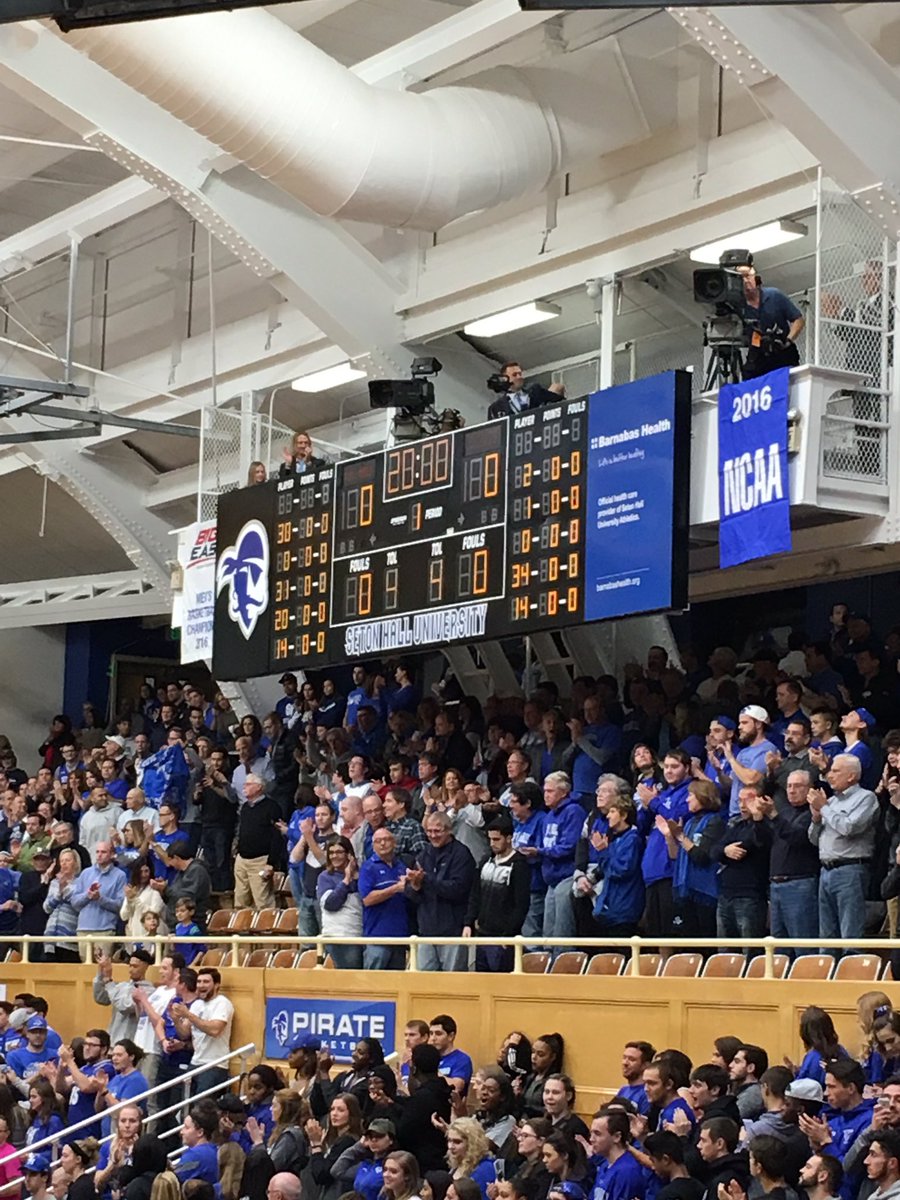
Big East championship and NCAA Tournament banner unveilings were two of many highlights for Seton Hall, who rolled past Fairleigh Dickinson in season opener. (Photo by Jason Guerette/Daly Dose Of Hoops)
SOUTH ORANGE, NJ -- Banner night turned into a banner win for Seton Hall.
Honoring last season's Big East championship squad in a pregame ceremony, the Pirates proceeded to pick up where they left off last March, emerging from a hard-fought first half to cruise to a season-opening 91-70 victory over in-state rival Fairleigh Dickinson inside Walsh Gymnasium.
"We just tried to come out and prove to everybody that we were good," said Khadeen Carrington, who tied a career-high with 27 points to lead Seton Hall in the winning effort. "This year, we still have something to prove early. A lot of people think we're not good since Isaiah (Whitehead) left, so we still have something to prove."
Following a defensive struggle in the opening stanza that saw the Pirates take a tenuous 33-28 lead into the locker room at halftime, both teams proceeded to torch the nets after the intermission, the Hall doing so to the tune of 79 percent (22-for-28) over the final 20 minutes. While Angel Delgado (22 points, 14 rebounds) and Desi Rodriguez (12 points, 10 rebounds) both posted double-doubles, it was Carrington in particular who took the game over down the stretch, quietly racking up basket upon basket as he and his teammates fed off a sellout crowd in their on-campus gym.
"We were rushing," Carrington said of the first half inefficiency, even though the Pirates held FDU to just 29 percent (10-for-34) shooting before halftime. "I had a conversation with Sha (assistant coach Shaheen Holloway) and he told me I was rushing. I just tried to take what the defense gave me, hit all my open shots, regular things I always work on. That's what I tried to do."
Playing without Earl Potts Jr., the most valuable player in last season's Northeast Conference tournament who continues to recover from a foot injury, FDU fought valiantly, but proved to be no match for a bigger and more physical Seton Hall team. The Pirates outmuscled the visiting Knights by a 52-18 margin in the paint, while outrebounding them 43-30. Despite the glaring disparities, the contest proved to be a positive in the big picture.
"I was really very proud of our team," FDU head coach Greg Herenda admitted. "I thought we withstood a lot of runs, but we competed. It took a lot of energy to play against that basketball team in a tough environment, and in the second half, Delgado was just a man. I just didn't think we had enough to combat those guys, and the score represents that."
Darian Anderson paced the Knights with 27 points, matching Carrington for the game high, further solidifying the confidence gained by the reigning NEC champions.
"I don't like accruing confidence from failure, but you have to," Herenda revealed. "That's college basketball. I have a lot of confidence coming out of this game. In totality, I'm very happy with my team. I saw a lot of things that we can build upon."
Seton Hall will raise two more banners to the rafters on Sunday, as they return to the Prudential Center to host Central Connecticut State in a 2 p.m. tipoff from Newark.
Seton Hall youth serves win in season opener
SOUTH ORANGE, NJ -- When assessing the prospects of a youthful Seton Hall team, Tony Bozzella stressed the need for his group to find consistency.
For most of the morning and afternoon Friday, his Pirates heeded their coach's advice, looking like a veteran team more often than not.
"I said to the girls, 'any time you win, you have to be happy,'" Bozzella said after Seton Hall overcame a tense opening quarter to emerge with a 74-60 victory over Savannah State in their maiden contest of the 2016-17 season. "The first game's hard. At one point, we played seven freshmen who had never played a college basketball game before, and played without a senior on the floor. Anytime you can get a win, that's fine."
Three Pirates posted double-figure scoring totals in the winning effort, led by JaQuan Jackson's 21, a tally that validated her coach's praise of her scoring potential.
"I think I took pretty good shots, but they just didn't fall," said the junior guard, who amassed her 21 points on 7-of-18 shooting. "They'll fall eventually."
Jackson was aided by Seton Hall's two-headed point guard attack of sophomore LaTecia Smith and freshman Kaela Hilaire, who combined not only for 26 points, but also nine assists and eight steals on a day where the Hall's patented transition game ultimately sealed the outcome.
"I thought KK did a good job and TT's playing the best she's played since she's been in this program," said Bozzella of his two primary facilitators. "They're young kids, but they're going to get better."
"We play well together, but we also play well off of each other," Hilaire added, addressing the on-court camaraderie between her teammates. "We all depend on each other and without the bigs today, we filled their spots really well."
Despite Savannah State wresting away a brief lead midway through the opening quarter, each period provided a different takeaway for Seton Hall. From Jackson's eight points to set the offensive tone to the emergence of Hilaire and Smith in the middle quarters, to the defense salting away a win at the end, it was as close to a complete effort as you can get for a team bereft of experience in a game of first impressions.
"I think the effort was good," Bozzella admitted. "Our freshmen get down on themselves because they're used to being successful every second. They've got to learn to be a little less hard on themselves and learn to be more positive. We're getting there. I was happy overall that we stayed to it, we controlled the game for the most part, and we won."
With one game under their belts, Seton Hall heads into a strong test Tuesday evening, taking on Marist for the first time in school history. Although the Pirates and Red Foxes have never faced off, Bozzella is more than acquainted with Marist head coach Brian Giorgis from his time at Metro Atlantic Athletic Conference rival Iona, and will be looking for his first career victory against his former adversary in what will be his 29th attempt.
"I think we're going to need to play a little more consistent for 40 minutes," Bozzella said, previewing Tuesday's clash in the Hudson Valley. "We're also going to need to defend better, but hopefully our athleticism and our ability to create turnovers will hurt them. They're very young at the guard spot, they're very young everywhere, so hopefully our defense will be tougher for them to dissect."
For most of the morning and afternoon Friday, his Pirates heeded their coach's advice, looking like a veteran team more often than not.
"I said to the girls, 'any time you win, you have to be happy,'" Bozzella said after Seton Hall overcame a tense opening quarter to emerge with a 74-60 victory over Savannah State in their maiden contest of the 2016-17 season. "The first game's hard. At one point, we played seven freshmen who had never played a college basketball game before, and played without a senior on the floor. Anytime you can get a win, that's fine."
Three Pirates posted double-figure scoring totals in the winning effort, led by JaQuan Jackson's 21, a tally that validated her coach's praise of her scoring potential.
"I think I took pretty good shots, but they just didn't fall," said the junior guard, who amassed her 21 points on 7-of-18 shooting. "They'll fall eventually."
Jackson was aided by Seton Hall's two-headed point guard attack of sophomore LaTecia Smith and freshman Kaela Hilaire, who combined not only for 26 points, but also nine assists and eight steals on a day where the Hall's patented transition game ultimately sealed the outcome.
"I thought KK did a good job and TT's playing the best she's played since she's been in this program," said Bozzella of his two primary facilitators. "They're young kids, but they're going to get better."
"We play well together, but we also play well off of each other," Hilaire added, addressing the on-court camaraderie between her teammates. "We all depend on each other and without the bigs today, we filled their spots really well."
Despite Savannah State wresting away a brief lead midway through the opening quarter, each period provided a different takeaway for Seton Hall. From Jackson's eight points to set the offensive tone to the emergence of Hilaire and Smith in the middle quarters, to the defense salting away a win at the end, it was as close to a complete effort as you can get for a team bereft of experience in a game of first impressions.
"I think the effort was good," Bozzella admitted. "Our freshmen get down on themselves because they're used to being successful every second. They've got to learn to be a little less hard on themselves and learn to be more positive. We're getting there. I was happy overall that we stayed to it, we controlled the game for the most part, and we won."
With one game under their belts, Seton Hall heads into a strong test Tuesday evening, taking on Marist for the first time in school history. Although the Pirates and Red Foxes have never faced off, Bozzella is more than acquainted with Marist head coach Brian Giorgis from his time at Metro Atlantic Athletic Conference rival Iona, and will be looking for his first career victory against his former adversary in what will be his 29th attempt.
"I think we're going to need to play a little more consistent for 40 minutes," Bozzella said, previewing Tuesday's clash in the Hudson Valley. "We're also going to need to defend better, but hopefully our athleticism and our ability to create turnovers will hurt them. They're very young at the guard spot, they're very young everywhere, so hopefully our defense will be tougher for them to dissect."
Steve Masiello: Coach of a lifetime

Beneath the unbridled intensity of Steve Masiello lies a man fiercely loyal and devoted to everyone he connects with, the side fans seldom see after the final buzzer. (Photo by Kevin Fuhrmann/Manhattan Quadrangle)
Editor's Note: This article originally appeared in the April 25, 2016 edition of the Manhattan Quadrangle, and was reprinted with the permission of the author.
By Jonathan Reyes
They only see the side of him that’s very intense, driven; and a passionate for his program, players and winning whenever there is a home game in Draddy Gymnasium or any place there is a road game.
There’s another side of him that not many people have the privilege to see and experience, the one that Seton Hall head coach Kevin Willard calls “a very loyal friend” from their time together when they were both assistants for the Louisville Cardinals from 2005, when Masiello arrived, to 2007, when Willard went on to coach the Iona Gaels for three years.
“I don’t think a lot of people get to know Stevie. It’s Stevie Mas, it’s not Steve Masiello,” Willard said. “Stevie’s very laid-back, easygoing, has a great sense of humor and has a great wit about him. I’ve been lucky to get to know both sides of him.”
Masiello’s personality didn’t derive from coaching, at least not all of it. It came from someplace much more personal, someone close to him. A person he definitively labeled his “best friend,” his father, Stephen Masiello Sr.
MR. MAS
Masiello’s father would wake up everyday at 6 a.m., travel to his 120,000-square foot warehouse that he owned in the South Bronx and work for 12 hours.
Masiello remembered his dad telling him quite often, “I do what I have to do, so you’ll never have to do what I have to do.” He added that his dad would call him on his days off, say going back to high school for example, around 8:30 a.m. to tell him, “Get up. Let’s go. Start your day. What are you doing? Get to work.”
“He’s a big cause for everything in my life,” Masiello said. “I would have to say my mother, Kit, is a big part of my motivation. My father, he taught me how to do things. My dad was a guy that had an answer or a solution for almost any problem I ever went to him with. He had a phenomenal way of seeing what was ahead, if you went down a certain road, good or bad. The best way I could describe my father is he connected every dot before you actually connected the dots, he already had them connected for you.”
Then came the day no one wants to experience or ever expects to happen. On December 16, 2008, at the age of 56, Masiello’s father died of natural causes. Masiello said he remembered that morning he was on his way to work and when he checked his e-mail, his dad had already sent him a message at around 6:18 a.m. His dad wanted to let Masiello know how proud he was of him and how much he meant to him, including their relationship.
“Stevie’s dad was everything to Stevie,” Willard said. “It was a really tough time losing Mr. Mas, for a lot of people. Mr. Mas was very important in people’s lives. Stevie was very connected to basketball through Mr. Mas. It rocked him for a while, losing his father, it took a couple of years for him to kind of recover from that.”
“Every professional person you can think of would go to his warehouse to talk to him to get advice,” Masiello said. “It was almost like an urban legend. The thing that was so amazing to me was that when he passed, how many people I found myself consoling for what he meant to so many other people. Here I am I’m like, ‘Wait. It’s my father. You’re supposed to be consoling me.’ And here I am consoling people that it’s going to be okay.”
“He was my best friend. We spoke like five times a day. We didn’t do much without each other. He was a special, special man.”
TITLE ROLE OF COACH IN JASPER NATION
After the news on April 15, 2016 that Chris Beard, newly hired as the UNLV Rebels head men’s basketball coach, decided to leave the Rebels for the Texas Tech Raiders less than a month after being appointed to the position, the Rebels shifted their focus on securing the only other finalist for the, again, vacant spot: Marvin Menzies, then-New Mexico State Aggies coach.
When Menzies’ name resurfaced, he hadn’t even been given the reins to the Rebels just yet, and he said Masiello; with whom he worked alongside as fellow assistants with the Louisville Cardinals from 2005 to 2007, called him right away and told him, “Okay, let’s talk about what you think we need. Let’s bounce some stuff off each other.”
“He’s like a little brother to me,” Menzies said. “When times are tough going throughout the season, we talk several times and we’ll bounce things off each other, as great sounding boards for each other. It’s a blessing to have him in that role.”
“He’s a guy that if you’re in his family and you’re a part of his extended circle of people that he supports, then he’s all in. And you could rely on him for whatever you needed, he’s just solid like that. Some of those characteristics would pop up in different ways throughout the years that we worked together, I saw them over and over again. He still does that to this day.”
Masiello’s loyalty as a friend is what has found him success as a coach and why he is able to connect with his players so well. Willard said he saw that in 2015, when the Jaspers won their second-straight Metro Atlantic Athletic Conference championship. He said Masiello has evolved as a coach, which has allowed his players to evolve at the same time. Willard continued on to say that Masiello’s maturity as a coach has led to some adjustments in doing things differently.
“His players see the real softer side of Stevie,” Willard said. “It compliments him because his players respect the fact that he’s intense and wants what’s best for them, but at the same time, he’s fun to hang out with and is relaxed. That’s why guys like to play for him so much.”
“One of the things that’s very appealing for players to Steve was that he’s so passionate about the game, and they have this common bond,” Menzies said. “But he’s very straight-ahead, direct with the guys; he always tells them the truth. He always would say, ‘I might not always be right, but I’m always going to tell you the things that come from the right place of motivation.’ The thing that they like about him is that he’s so real with them.”
One of Masiello’s former players who still has fond memories of his time as a Jasper, but more so of the relationship he continues to keep with Masiello, is Trevor Glassman. When Glassman transferred to Manhattan originally, he was shooting around in the gym when, with no introduction, Masiello said to him, “You have to stop flicking your guide hand, and keep it still when you shoot.” Glassman said he knew right then and there that this was someone who was going to pay attention to details, it didn’t matter if it had to do with coaching or building a personal relationship with his players.
“He reminded me more of a father figure than a coach,” Glassman; who was a part of the Jaspers’ back-to- back MAAC championship teams and is currently a Missouri Tigers guard, said. “He walked around like he was a boss, honestly, he carried himself well. He’s a great guy to have in your life, that’s something outside of basketball that’s even more of an accolade to him. I truly value every moment I had at Manhattan, but him and I have had some pretty good moments too. I’ve brought it with me wherever I’ve gone. I’m fortunate to have been coached by him.”
Glassman is just one example of past or present Masiello players who he has an impact on, on-court and off. When Masiello was asked about what that means to him, he said it’s beginning to be the favorite part of his job and something that is affecting him in his own life.
“The thing I’m starting to get the most joy in is when I get a phone call from an Emmy Andujar, who’s in Spain,” Masiello said, “and talking to me about his new contract he’s going to sign next year. Or going through the agent process with Shane Richards, and seeing the demand that he’s in. You’re starting to see, four or five years in, the affects of that we’re having on these guys in becoming men, we’re changing their lives. That’s powerful stuff.”
“To think that we’re putting guys in situations for guys’ hard work, sacrifice and their investment in themselves is starting to pay returns, and I’m not just saying that financially I’m saying that in multiple ways. And they’re achieving things they’ve never even dreamed about in their life. That’s really, really powerful for me. I’d put that up there with winning the MAAC championship, maybe even more. The fact that the feeling I get when I hear the things that are going on with a George Beamon or a Rhamel or an Emmy, it’s life-changing.”
Analytics becoming a greater part of the game for NEC women's basketball coaches

As basketball continues to evolve into more analytical facets, Sacred Heart's Jessica Mannetti is one of several coaches looking further inside the numbers to assist in game planning. (Photo by Ray Floriani/Daly Dose Of Hoops)
By Ray Floriani (@rfloriani)
Timeout is called. Prior to meeting with the team, the head and assistant coaches huddle. Assistants provide data that has been charted. The head coach takes it all in, processing as the precious seconds tick. Finally, a decision is made and the staff addresses the group before sending them on the floor.
It is a scene happening several times a game. There has been a change, though: A big change at that.
In the not too distant past, the information jotted on the clipboards included points for and against since the last timeout, who is in foul trouble, remaining timeouts and possibly a breakdown of scoring (for and allowed) by defense. Today, that information is much more complex. Teams will approach the numbers from an analytic and efficiency orientation. Said assistant may, or should among other items, have information on the most effective out-of-bounds play, citing offensive efficiency as evidence. The numbers game is very much in vogue.
Less than a decade back, those tracking efficiency and similar analytics were considered ‘stat nerds.’ Well, the nerds have taken over with a big bang, to pardon the expression. Programs want an edge. The numbers are considered a means to that end. At the recent Northeast Conference media day, the women’s programs were queried regarding the use of advanced statistics and analytics. Of the schools we talked with, each did use tempo-free numbers and/or analytics.
The tempo-free movement began over half a century ago. A young coach by the name of Dean Smith felt scoring averages and defense were misleading because teams often played at a varying pace. Smith devised a formula to measure points per possession, a better judge of how efficient and proficient a team was.
In the early 2000s Dean Oliver published his excellent ‘Basketball on Paper,’ a bible for those studying the numbers of the game. Shortly after, Basketball Prospectus was a leading online site that also published several college annuals. For over the last decade, we have been enlightened by the work of Ken Pomeroy and his must see KenPom site.
Fan sites of a number of college teams have utilized tempo-free, so much to the extent preseason primer is no longer a requisite. Fans know turnover rate, how it is computed and interpreted. Analytics has become a bit more recent. Players are tracked and data can be broken down by offensive or defensive set, for instance. Analytics is more involved on studying teams rather than individuals. Synergy Sports Technology puts out a website a number of schools subscribe to.
Plus-minus. It simply takes the points scored minus the points allowed while you are on the floor. Some swear by it. Others swear at it. The reasoning is if you are on a good team, you should have a positive plus-minus. Conversely, those on a poor team, no matter how extensive their contributions, are often doomed to be in the red.
Heather Jacobs, Wagner’s new head coach, realizes this. Despite her feelings on plus-minus shortcomings, Jacobs does see it being used in another way. “You can look at rotations,” Jacobs said. “You can get an idea which group is most effective.” While calling the tempo-free movement and all its features ‘pretty cool,’ she is careful what to use. “We want analytics and tempo-free to show our players to value the ball.” In that end, possessions, turnovers and the accompanying turnover rate are paramount. Jacobs embraces analytics with a caution. “We don’t want the numbers to be over bearing,” she said. “We want to keep it as simple as possible for our players.”
Jessica Mannetti is another one not particularly in favor of plus-minus. The Sacred Heart mentor feels there are better ways to measure an individual’s performance. From her perspective, Mannetti is more concerned with team measurements.
“In our system, we like to push the ball and play at a faster tempo,” Mannetti said. “We are looking at points per possession and breaking things down from a half-court versus transition offense, in other words, what is our efficiency in each case.” Turnovers, or their minimizing them, are studied closely. Told the turnover rate cutoff was 20 percent (over that is not offensively acceptable,) Mannetti countered. “We can accept just a little over that 20 percent rate. With our pace, we have more possessions and some margin of error.”
Scouting the opposition is a valuable part of tempo-free and analytic breakdowns. LIU Brooklyn’s Stephanie Oliver utilizes numbers to closely monitor the turnover rate and offensive rebounding percentage of her club and the opposition. The second-year LIU mentor is one apt to employ the numbers to study her own club a lot more closely.
“You can really see more things about your team,” Oliver stated. “The breakdowns can tell you what out-of-bounds plays are working better (by efficiency totals) and even where your own players’ scoring tendencies lie. Watching and observing are important naturally, but the numbers can uncover much more.”
“I love it,” Saint Francis University coach Joe Haigh enthusiastically declared when asked about tempo-free studies.”We chart possessions and study the efficiency of each offense we run.” Haigh takes it further, providing his club with offensive and defensive efficiency numbers for each game. He proudly notes the Red Flash in conference play last season, for the first time in several years, had a higher offensive efficiency than that allowed on their defensive end. “The numbers prove a point. We want to limit turnovers and get more shots than our opponents. Players see the turnover rate and offensive rebounding percentage, they get a point of reference. The numbers are so helpful. They are great when you want to make a point.”
At FDU, Pete Cinella is utilizing the Synergy website to devise a plan. Cinella lost inside threat Erika Livermore and a good penetrating guard, Kelsey Cruz, to graduation. Points in the paint may be more difficult to come by for the Knights, so Cinella is studying the trends of teams, college and pro, that utilize the three-pointer. He is looking into three-point success and its relation to offensive efficiency. During the season, Cinella constantly consults with Synergy. “We look at our offensive efficiency per play,” he said. “We study opposition efficiency and we look at our own efficiency versus man and zone, on offense and defense.” Synergy is a tool used in practice quite frequently. “It helps my game,” FDU’s Brianna Thomas, a redshirt senior forward, said. “I look at how I am doing against defenses, and what areas improvement is needed.”
Beryl Piper of Central Connecticut State also uses Synergy. Her emphasis is centered on the assist/turnover ratio. “We compare each game in that category,” she said. “We want to know if we were outrebounded and who we were able to outrebound. Beyond numbers, Synergy can give us reasons why.” Synergy has also given Piper insights not available just a few years back. “You can study the fast break and find how less efficient you may be if you need more than one (pass) reversal in transition. This is interesting, and the players really buy into these ideas.”
There is no magic formula guaranteeing a potential conference cellar dweller will cut down the nets come March. Nor is there an equation, duly followed, that will lead to a big upset. If there were, UConn’s opponents would like to hear of it.
Each of the six coaches in the discussion embraced advanced statistics and analytics. Interestingly, their orientation was similar, but specific needs and uses varied with their individual program. What analytics, tempo-free, whatever the term utilized, can do is get your team as prepared as best able. The ability to put your players in the best possible position to maximize their strengths and minimize deficiencies can be achieved. That is the essence of coaching, as good a reason as any why more coaches are enthusiastically buying into the numbers and analytics these days.
Subscribe to:
Posts (Atom)