Thursday, July 21, 2022

Remembering J.P. Pelzman, a great writer and even better friend

J.P. Pelzman (right) surveys landscape in Madison Square Garden press room during Big East tournament. Pelzman, a longtime Seton Hall beat writer, passed away this week at age 57. (Photo by Jerry Carino/Gannett New Jersey)

Far too many times, we are dealt one sobering reminder after another that life is truly a blessing, and therefore, each moment should be celebrated to the fullest extent possible, for the prospect of tomorrow is never guaranteed.

Thursday afternoon served as yet another haunting caveat to such an uncertainty, coming to this writer in the form of a call from Peter Long, the men’s basketball media contact at Seton Hall, a program that has been central to this site’s brand and operation for most of the past decade. The message was one that is still difficult to process, and — given the subject — will be for quite some time.

It was at that moment that I learned J.P. Pelzman, longtime Pirate beat writer for the Bergen Record, where he also covered the New York Jets for many years after his tenure at Newsday (or “Snoozeday,” as he would jokingly refer to the Long Island periodical, one of his many memorable quips), had passed away earlier this week, leaving us at the way-too-early age of 57 but leaving behind a legacy and collection of memories that will be truly irreplaceable.

Anyone who covered Seton Hall, even just once, never forgot J.P. after meeting him. He would be the first person you would see upon checking into the Prudential Center press room, setting up shop at the first desk along the left side wall, usually with a plate of chicken fingers and french fries to keep him company. Sometimes irreverent, and ever the jokester — his impressions of fellow colleague Roger Rubin and more famously, Mike Francesa, would always be well-received in whatever workspace we shared — J.P.’s deft ability to straddle the line between levity and professionalism was unmatched by all of us, but always aspired to. When I started making more treks into Newark after expanding the scope of the site’s coverage, he welcomed me into the Pirate media family that still remains the favorite media circle to which I belong. Many a night came and went over the years where J.P., Jerry Carino, Brendan Prunty, Zach Braziller, John Fanta, Adam Zagoria, Jeremy Schneider, Jim Hague, Josh Adams, Jason Guerette and myself would go off on some tangent about another game, something else that may have occurred in the industry, or just a random musing after filing our postgame dispatches, and we would stretch the reverie late into the night before shutting the arena down. Those nights were not just an indoctrination into the life of a journalist, but now, memories that will be held a little closer for all eternity.

But behind what a stranger might perceive as a gruff exterior, and the endless Francesa jokes and Rex Ryan riffs, was an outsized heart to match the vast reaches of his gregarious personality. J.P. would never hesitate to assist anyone in any way, be it offering unsolicited yet always appreciated tips on how to improve in the business or different angles from which to approach a story, or simply complimenting you for the work you did yourself. 

After his mother had passed away several years ago, J.P. and I became closer, as we had more in common beyond the hardwood than either of us initially realized, having both come from broken homes and been raised primarily by single mothers. Through that tragedy, his being a victim of downsizing and penny pinching by Gannett, recurring health scares, and the pandemic, I made it a point to check in with him whenever possible, and looking back, I was glad I did. It’s a shame that the last two years cheated everyone in the media out of experiencing J.P.’s genius and professionalism, because his absence left a void among us that can never be adequately filled. 

Just last month, I had the honor of inviting him onto the Daly Dose Of Hoops podcast and instantly returned the favor when he interviewed me in a longform feature on Rivals.com that now stands among his final bylines. On both occasions, we spoke of the crossroads I came to in the middle of last season before the NCAA Tournament revitalized me and helped me realize I still had more to offer, and hearing him say that the New York/New Jersey college basketball landscape would be better off for having this site among it was an endorsement that meant more than he may have realized. But that was J.P. Pelzman in a nutshell. He made a far greater impact on every life he affected, but to him, it was just standard practice, a way of life.

As I mentioned earlier, writing these words and eulogizing J.P. evokes a state of shock that will not soon dissipate. I think, though, that he would appreciate the outpouring of kind words and fond recollections from his friends and colleagues as opposed to being recalled the way Mike Francesa acknowledged Tim Russert, Horace Clarke, Frank Robinson and Stan Lee in their final hours. You’re finally at peace now, my friend, and I hope you had a good week of practice and things, let me tell you. But I have one more question before I let you go:

Do you think J.P. Pelzman and Jason Pierre-Paul would ever have lunch sometime, kind of like a JPP get-together?

I’ll hang up and listen.

Thursday, May 12, 2022

Even in his final days, Bob Lanier remained larger than life

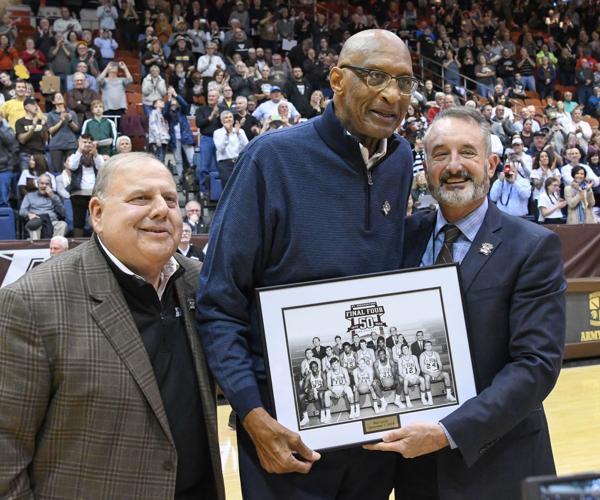
Shown here in 2019, Bob Lanier returned to St. Bonaventure as Bonnies’ 1970 Final Four team, on which he starred, was honored. Lanier passed away Tuesday evening at age 73. (Photo by the Olean Times Herald)

By Ray Floriani (@rfloriani)

The prognosis was not favorable. A battle with cancer resulted in hospitalization in an intensive care unit. Prayers were sent from so many who were fortunate to know or know of him. On the morning of May 11, the news came via social media. 

On his Facebook page, Paul Hoffman, a sophomore starting guard on the 1970 St. Bonaventure Final Four team simply said, “RIP Bob.” Hoffman’s page, with the 1970 team picture in the background, told you all you needed to know about his feelings that day. 

Bob Lanier, at age 73, had passed. 

Similar messages soon flooded social media to remember Lanier, a truly great player, and a truly greater human being.

Lanier’s basketball career began in a humble manner. The 6-foot-6, 240-pound sophomore was cut from his Bennett (Buffalo, NY) High School team. Lanier was determined to prove the man who made the cut, coach Nick Mogavero, wrong. He worked tirelessly and eventually became an All-High choice his junior and senior years at Bennett, then praised Mogavero in a 1990 Buffalo News article, calling him a “very perceptive and compassionate coach, and a hell of a human being.” Lanier had approximately 80 scholarship offers and chose to play for St. Bonaventure and coach Larry Weise.

By the time his college days began, Lanier had grown to 6’11” and into a three-time Converse All-America selection for the Bonnies, ending his Bona career holding records in seven categories including points (2,067), points per game (27.6) and rebounds (1,180). In his sophomore year, as a key member of Bona’s original iron five (Bill Butler, Billy Kalbaugh, John Hayes, Jim Satalin and Lanier), the Bonnies fashioned a perfect 26-0 in the regular season, suffering their only loss in the NCAA Tournament to North Carolina in the East Regional semifinals. Lanier’s junior year saw the Bonnies finish 17-7.

Mention Lanier’s college career and that 1970 team instantly appears in the mind’s eye. A team he led to the Final Four, yet never got to play in after suffering a knee injury in the regional final against Villanova. A team on a mission. The debate continues even today. Could the Bonnies have dethroned reigning champion UCLA with Lanier? The issue is not really debatable among Bona faithful who wholeheartedly know the answer.

The first pick of the 1970 NBA Draft, Lanier enjoyed a 14-year career in the NBA, playing for the Detroit Pistons and the Milwaukee Bucks, becoming an eight time NBA All-Star. He was chosen MVP of the 1974 All-Star Game, with his number 16 retired by both the Pistons and Bucks. Following retirement, Lanier was an assistant coach for the Golden State Warriors, and later, an interim head coach with the organization. He was inducted into the Naismith Hall of Fame in 1992.

Lanier won the NBA’s J. Walter Kennedy Citizenship Award for the 1977-78 season for outstanding community service. His contributions off the court continued after his size 22 sneakers made their way to Springfield. He started the NBA’s Stay in School, now called Read to Achieve, campaign. The program is supported by all 30 NBA teams, 13 WNBA teams and 6 NBDL teams. The initiative supports the value of literacy and encourages adults to read with young children. The Bob Lanier Center for Educational, Physical and Cultural Development was founded in Buffalo in 1994, serving the youth in the area.

Lanier’s influence was impacted beyond Buffalo. It was worldwide. 

In a statement, NBA commissioner Adam Silver said, “Bob Lanier was a Hall of Fame player and among the most talented players in the history of the NBA, but his impact on the league went far beyond what he accomplished on the court. For more than 30 years, Bob served as our global ambassador and as a special assistant to David Stern and to me, traveling the world to teach the game’s value and make a positive impact on young people everywhere. It was a labor of love for Bob, who was one of the kindest and most genuine people I have ever been around.”

Lanier was awarded an honorary doctorate by St. Bonaventure in 1985 and the Gaudette Medal in 2004. The latter honor is the university’s highest service award.

Lanier was one who gave so much of himself and thought of others. In 1971, his rookie season ended on a Sunday in Detroit. Two days later, the Bonnies were playing Hawaii in a second-round game at Madison Square Garden. Lanier was in attendance and visited the team following the win over the Rainbow Warriors. In 2012, the Bona women were preparing for a NCAA Regional meeting with Notre Dame. During practice, a call was made to coach Jim Crowley. It was Lanier. Practice was halted as Bob spoke with the team, praising them while adding a message: “Enjoy this and live in the moment.”

When Larry Weise was inducted into the Atlantic 10 Hall of Fame a few years ago during the conference’s tournament in Brooklyn, Lanier traveled from Arizona to take his coach and wife, Julie, out to a celebratory dinner. There were countless other stories exchanged by Bona fans and alums on social media.

Lanier was outstanding in the low post and could move out to hit the mid-range jump shot. The latter skill was virtually unheard of for big men in that era. Lanier was a player who could be an enforcer if need be. He also showed a compassionate side, even in the heat of battle. 

The late Edgar Cartotto, a long time officiating mentor to yours truly among many others in stripes, often told this story. Cartotto was working a game with the Bonnies facing Canisius in Buffalo Memorial Auditorium. 

“I was too fast on the whistle to call a jump ball as a split second later Lanier ripped the ball from the opponent and laid it in,” Cartotto said. “I told him, ‘Captain Lanier, I’m sorry, I kicked that call.’” Big Bob smiled and patted me on the back and said, “Eddie, no problem. Don't worry about it.” Cartotto went on to say he and Lanier became friends and Bob would send a card and call him each Christmas. “Bob Lanier,” Cartotto added, “was one of the finest human beings I ever knew.”

A fierce competitor, the fire burned inside and manifested itself on the court. In December 1969, the Bonnies were set to face Purdue and Rick Mount in the finals of the ECAC Holiday Festival at Madison Square Garden. Purdue’s center, Bill Franklin, said pregame that Lanier, known as the Big Cat was going to run into the big dog in Franklin. Lanier simply went out and dominated Franklin with a Holiday Festival record-tying (with Oscar Robertson and Jimmy Walker) 50-point performance. The Bonnies defeated Purdue handily. Purdue coach George King was asked what he should have done against Lanier by replying, “put a muzzle on Franklin.”

A few months later, the Bonnies were set to play Villanova in the Eastern Regional finals. Back in the day, there were consolation games in the regionals. The St. Bonaventure players took their seats to watch the third-place game. A few rows ahead, Villanova guard Fran O’Hanlon was heard telling his girlfriend that since the Wildcats handed Bonaventure its only loss — a two-point setback at Villanova — they should be in very good shape to advance. Lanier heard the remark, simply said to his teammates, “let’s go,” and led them to the locker room to get ready. The Bonnies dominated the Wildcats in convincing fashion.

The Bonnies advanced to the Final Four, as noted previously, without Lanier, who suffered a knee injury late in the game. Decades have passed, yet the collective memories and emotions of 1970 have not. They affected Lanier deeply.

At the 2007 dedication of Bob Lanier Court at Reilly Center, Lanier was driven to tears recalling the disappointment of not playing in the 1970 Final Four. 

“We were kind of warriors, in this trench together,” Lanier was quoted by the St. Bonaventure website. “We had one focus, to win an NCAA title.” It hurt to watch the Bonnies drop a hotly contested national semifinal to Jacksonville as he recuperated, after knee surgery, in a hospital room.

Lanier stayed close with those 1970 teammates, often organizing reunions of the group through the years. In 2018 when the Bonnies faced UCLA in a NCAA First Four meeting in Dayton, coach Mark Schmidt had a pregame history lesson to make sure his club understood the meaning and significance of 1970. The Bonnies upset the Bruins on that memorable evening. Postgame, Schmidt remembered that 1970 team, and in an extreme touch of class and devotion, dedicated the win to them and their leader, Bob Lanier.

His health an issue, Lanier still made the trip to Olean in December of 2019 for the St. Bonaventure Basketball Centennial. He went to a team practice, not just to stop by, but talk to the players as a group and individually, especially big man Osun Osunniyi. Lanier graciously spent time with former teammates, fellow alums and friends over the course of that December weekend.

Among the outpouring of tributes pouring in, several stand out. Joe Manhertz, St. Bonaventure Director of Athletics noted:

“It was very sad to learn of the passing of Bob Lanier. He meant so much to so many people. Bob represented the best of what it was to be a St. Bonaventure Bonnie in competition and in selfless service to others. WE will miss him, but we will always celebrate him and continue to carry on his incredible legacy.”

“I had many good teams, but when Bob enrolled at St. Bonaventure University, he brought our program to a national level,” his college coach, Larry Weise, said. “Bob was not only a great basketball player, he was a wonderful person. He had an infectious personality and everyone liked him. He had a sense of humor as big as he was. He loved to laugh. God keep him safe.”

Mike Vaccaro, a 1989 St. Bonaventure graduate and New York Post columnist, summed it up in a most eloquent and meaningful fashion: 

“The spirit of St. Bonaventure is bigger than any one man, but no singular soul in 164 years has ever brought more honor, dignity, glory and love to bear at Bona’s than Bob Lanier. Bob transcended race, united a campus and, by the way, was one of the best basketball players who ever lived. He will be synonymous with St. Bonaventure eternally.”

Current Bonnies head coach Mark Schmidt told The Buffalo News, “Bob Lanier IS St. Bonaventure basketball. What says everything about Bob is that he was so humble and you would never know he was one of the top 50 players of all time. There’s not enough to say about what he means.”

Former Bona mentor and teammate Jim Satalin said in the same article, “From a basketball standpoint, he put St. Bonaventure on the map,” Satalin said. “He did so many things in the community and he did them for free. He did things nobody even knew about.”

Bob Lanier enjoyed life and leaves an indelible mark on us all. Many players, especially today, take what they can from the game. Lanier, in the final analysis, utilized the game as a method of reaching others, practicing the Franciscan and Bonaventure value of service.

He will be missed by his immediate family. Also by his Bonaventure family, in effect an extension of his immediate one. His contributions were immeasurable, and never will be forgotten.

Thursday, May 5, 2022

St. John’s notebook: Jones commits, potential target for last scholarship, OOC updates

DePaul’s David Jones joins Andre Curbelo as incoming transfers for Mike Anderson and St. John’s. (Photo by Rumble in the Garden)

By Jason Dimaio (@JasonDimaio1)

In what has been a surprising offseason so far for St. John’s, the Red Storm continued to turn heads with the addition of forward David Jones from DePaul.

The addition of Jones, a native of the Dominican Republic with two years of eligibility remaining, immediately improves a St. John’s roster that was desperate for a wing and a scorer following the departures of Julian Champagnie and Aaron Wheeler to the professional ranks. Jones averaged 14 points and 7 rebounds last year for the Blue Demons before choosing Johnnies over Illinois, Oregon and West Virginia after entering the transfer portal in April. 

The relationships Jones has with Joel Soriano and Andre Curbelo — who joined the program last month after transferring from Illinois — seemed to be a big factor in getting him to commit to St. John’s, as did the close proximity of several friends and family members, not to mention the recruiting efforts of assistant coach Greg “Shoes” Vetrone. Simply put, Jones fits the St. John’s program like a glove and provides a much-needed talent boost at the forward position.

Pieces are now starting to fall in place for St. John’s, as only one scholarship remains open. Tobe Akawa, a Class of 2022 prospect from Cardinal Hayes High School in the Bronx, has been on the radar of Mike Anderson’s staff, but he’s not alone as Pitt and Maryland are also in the mix, each having recently offered the senior. The Red Storm still needs a shooter to help fill the void left by Champagnie and Wheeler. If the Johnnies can land an impact shooter to complement the skill sets of Curbelo, Posh Alexander and Jones, the Red Storm will be a serious contender to finish near the top of the Big East, but potential and results are two very different things, as St. John’s fans know after the disappointment of this past year.

Mike Anderson's staff is known for working quietly, so it’s not clear who the Red Storm is exactly in on in the transfer portal, if anyone at all. It would not come as a surprise to some if St. John’s decided to not fill the last spot on the roster as there is somewhat of a backloaded roster after the starting five, but a name that can fit the Johnnies is St. Bonaventure transfer Dominick Welch. Welch has one year of eligibility left and averaged 12.3 points per game and 37 percent from 3-point range.

Will St. John’s reach out? Will the Red Storm go somewhere else, if anywhere at all? Time will tell but in what was looking like what might be a reset year in Queens, the narrative has quickly changed, and it will be interesting to see where things go from here.

NON-CONFERENCE SCHEDULE UPDATE: In addition to the previously announced game against Florida State in the Orange Bowl Classic on December 17, St. John’s will be opening its season at home on November 7 against Merrimack, as reported by CBS Sports college basketball insider Jon Rothstein.

Monday, May 2, 2022

Mount St. Mary’s to leave NEC and join MAAC, replacing Monmouth

Shown here after winning NEC championship in 2021, Mount St. Mary’s will now join MAAC as league replaces Monmouth. (Photo by Mount St. Mary’s Athletics)

In 2013, after Loyola University left the Metro Atlantic Athletic Conference for the Patriot League, MAAC commissioner Rich Ensor was proactive in finding a replacement, extending invitations to Quinnipiac and Monmouth to leave the Northeast Conference.

Nine years later, as Monmouth is on the verge of leaving the MAAC to join the Colonial Athletic Association, Ensor has again reached into the NEC to find a successor, tabbing Mount St. Mary’s as the newest MAAC member. The Mountaineers will officially begin their tenure as the MAAC’s 11th institution on July 1, with a press conference to be held on campus Tuesday morning.

“On behalf of the MAAC Council of Presidents and the Committee on Athletic Administration, I am pleased to announce that Mount St. Mary’s University has been offered and has accepted membership in the Metro Atlantic Athletic Conference, effective July 1, 2022,” Ensor said in a joint release issued by both the university and the MAAC. “The MAAC membership has sought to maintain a brand that stresses excellence in academics and athletics, and Mount St. Mary’s fully meets those criteria.”

“Today is a great day in the history of Mount St. Mary’s University,” Mount St. Mary’s president Dr. Timothy Trainor echoed. “In joining the Metro Atlantic Athletic Conference, The Mount gains the opportunity to compete with some of the finest Catholic colleges in the Northeast, elevating the university’s brand as well as the level of competition for our nearly 600 student-athletes and coaches.”

Since joining the NEC in 1989 upon its transition to Division I, Mount St. Mary’s established itself as one of the more successful men’s basketball programs in the conference, appearing in six NCAA Tournaments after claiming conference tournament crowns. Under the direction of the late great Jim Phelan, The Mount first tasted postseason glory in 1995 before winning the NEC again four years later. The Mountaineers would return to the NCAA Tournament in 2008 under Milan Brown, twice behind Jamion Christian in 2014 and 2017, and most recently, in 2021 with current head coach Dan Engelstad at the helm.

Mount St. Mary’s women’s basketball program also adds gravitas to the MAAC footprint, which returns to Maryland for the first time since 2013. On the women’s side, The Mount has nine NCAA Tournament appearances, the most recent of which having come in 2021 in tandem with the men’s program. Overall, Mount St. Mary’s captured 49 championships during its tenure in the NEC, and looks to raise its profile while maintaining its high expectations in the MAAC.

“What an exciting time for Mount St. Mary’s University,” athletic director Lynne Robinson reiterated. “I want to thank the MAAC Council of Presidents, the Committee on Athletic Administration, and commissioner Rich Ensor for giving us this tremendous opportunity to become a member of the MAAC.”

“We are honored to join this group of outstanding universities who all have strong traditions and proven commitment to academic excellence and student-athlete success. Joining the MAAC will no doubt energize the entire Mount community and enhance the experience of our student-athletes. We are eager to build upon our strong foundation of academic and athletic success as we begin this new chapter for Mount Athletics.”

Friday, April 22, 2022

For three decades, Jay did it his way, the Wright way

Jack Styczynski (left) interviews Jay Wright at Madison Square Garden in Big East Tournament. (Photo by Marc Ernay/1010 WINS, via Jack Styczynski)

By Jack Styczynski (@hoopsvista)
Special To Daly Dose Of Hoops

I'll never forget the first time I met him.

Jay Wright was entering his fourth of seven seasons as Hofstra's head basketball coach, and was holding a preseason practice. An alumnus of the school, I was on hand to write a story on his sophomore sensation Speedy Claxton for a new and relatively unknown web site.

Before things got started, Wright asked me my name and affiliation, and after the team broke its huddle, he called me over and said to the players, "This is Jack Styczynski with College Hoops Insider, and I want you guys to help him out today." 

When the day was over and I had everything I needed, Wright told me his sister was in the media business, he understood the profession, and he would always treat its members right. I had no idea where his career would ultimately go, but I was impressed. And I never saw him deviate from his promise.

A few years later when I was running the Hofstra site at Rivals.com, I got an even closer look at his program as he allowed me to spend an entire game day with the team. By that time, he had already led the school to its first NCAA Tournament berth in 23 years and I had a better idea he was headed for bigger things — and soon — but still had no clue I was hanging with a future Hall of Famer.

After leading the Flying Dutchmen to a second straight Big Dance, Villanova came calling. Wright had always followed the program, married a Villanova cheerleader, and eventually became an assistant coach there under Rollie Massimino. It was obviously a perfect fit. He had told me during that game day at Hofstra that Massimino had taught him about creating a family atmosphere and not to "mess with happy." He would achieve both as head coach on the Main Line, making it his ultimate stop.

Although I never covered his Villanova teams the way I did for his last two seasons at Hofstra, I did get his cooperation many more times for various stories on his squad or more general college basketball topics. He was a great quote and the only coach who ever asked me to e-mail him my work after it was written. I got a little bit of a laugh out of the fact that he always referred to me as "buddy" in person (as he did with a lot of the media), even though we had corresponded electronically many times and he introduced me to his players by name the first day we met.

Wright's 21 years as the head man at Villanova were not all smooth. The Wildcats fell short of the NCAA Tournament his first three, and after he got the ball rolling and they made the Final Four in 2009, things got rough again with a pair of late-season flameouts and a losing campaign between 2010 and 2012. By this time, I was a full-blown fan, so I was obviously thrilled when he turned things around once more, thanks largely to a point guard named Ryan Arcidiacono and a Big East Conference that was reconfigured in 2013 such that his program became the new king. By 2016, Arch was passing the ball to Kris Jenkins and "bang," Wright was a national champion.

Two years later, he had a juggernaut. The 2018 Wildcats ran through the NCAA Tournament with six double-digit victories and a squad featuring five future NBA players (not to mention Phil Booth). Now, Wright had two national titles and was clearly among the greatest ever college basketball coaches. The previous year, a panel of journalists had already ranked him the second best currently in the game, behind only Duke's Mike Krzyzewski.

In 2021, Wright was inducted into the Naismith Memorial Basketball Hall of Fame. Last month, he led his fourth team to the Final Four. And this past Wednesday, he retired from coaching at the relatively young age of 60 the same way he does everything, with class.

The Wright way.

What a ride.
Jay Wright patrols Villanova sideline against Seton Hall, with then-assistant Kyle Neptune (seated, first from Wright’s left) looking on. Neptune will succeed Wright as Wildcats’ head coach after one season at Fordham. (Photo by Bob Dea/Daly Dose Of Hoops)

Wednesday, April 20, 2022

Rick Pitino’s remarks advocate more for stronger MAAC, not for potential A-10 move

Rick Pitino addressed Iona’s offseason and non-conference schedule in Zoom call Tuesday, which also included push for MAAC to fortify its own standing. (Photo by Bob Dea/Daly Dose Of Hoops)

Rick Pitino took to the (virtual) airwaves Tuesday, conducting a Zoom call with members of the Iona media to reference the Gaels’ incoming six-man recruiting class and non-conference schedule for the 2022-23 season in the wake of winning 25 games, a regular season Metro Atlantic Athletic Conference championship, and appearing in the National Invitation Tournament.

After Pitino gave a primer on each new addition, highlighting that he recruited freshmen more heavily this season because — in his own words — “I didn’t want to lose sight of building a program,” he laid out the non-league gauntlet for Iona, which includes a home game against Saint Louis, trips to Hofstra and New Mexico, a meeting with Seton Hall at Madison Square Garden whose date still needs to be finalized, and appearances at Mohegan Sun Arena and Barclays Center against yet-unnamed opponents. Upon taking questions from the media, a particular quote about realignment made the rounds on social media and was quickly consumed and, to an extent, misinterpreted. Highlighting the Atlantic 10 Conference, Pitino had this to say:

“If Richmond didn’t upset Davidson, they would have only had, out of 14 teams, one team in the NCAA this year. But I believe, with Loyola Chicago coming in, with Archie Miller going to Rhode Island and Frank Martin going to UMass, the Atlantic 10 is going to take off, because they just hired awesome coaches.”

“So we need to get into a multi-bid league. Can the MAAC develop into something like that? I don’t know, it depends on who they’re bringing in. I don’t know what’s happening with that.”

At first blush, with no context and not reading between the lines, it is easy to misconstrue that as Pitino perhaps positioning Iona for a move to the Atlantic 10, which has NOT — repeat, NOT — been discussed in any serious capacity. However, this latest round of Pitino being brutally honest with regard to his program’s standing reads more as a plea for the MAAC to be more like the A-10 in how it projects itself as a basketball conference. “We need to get into a multi-bid league” should be taken more as an inadvertent slip of the tongue and read as “we need to BECOME a multi-bid league,” especially with the following quote about MAAC expansion, which has been rumored to include Mount St. Mary’s from the Northeast Conference, but nothing etched in stone:

“What bothers me more than anything about the MAAC is that they don’t bring the coaches or athletic directors in on who they’re trying to expand with,” Pitino said, citing the meetings with university and college presidents in regard to prospective new members. “We have no clue to who they’re expanding with. They don’t bring any of us in on that.”

Pitino is many things, most notably a Hall of Fame coach and two-time national champion who will forget more basketball than the majority of us will ever learn. And at the end of the day, his remarks should be taken as a passionate defense for his conference to think forwardly as opposed to simply maintaining the status quo, rather than as someone looking to take the first boat out of the harbor.

Sunday, April 17, 2022

A reaffirmed love of the game made this year a lucky No. 13

Shaheen Holloway and Saint Peter’s address fans during Jersey City parade for Peacocks, which ended this site’s 13th year of coverage. (Photo by Jaden Daly/Daly Dose Of Hoops)

Triskaidekaphobia.

Webster’s dictionary defines it as fear of the number thirteen. If you were a fan of any team that played Seton Hall in recent years, chances are you may have experienced it when having to go up against Myles Powell. Personally, idolizing Dan Marino as a little boy made me embrace No. 13 in all its forms, so I never had to worry about that superstition.

What I did fear, though, especially when covering this now-concluded season, was that I would lose my passion and the desire to share my experiences with all of you. After a year of watching games on a living room television, you would think that to be impossible considering fans were back in the stands and media was back courtside, right? Well, easier said than done.

When I created this outlet on this day in 2009, I wanted to pour the love and energy I had for broadcasting college basketball into my writing, and would only stop if it got to be a chore and the passion some of you have complimented me on started to fade away. I also try to be as transparent and straightforward with you as possible, because without your readership and support, I would have no reason to do what I do, so I’ll break the fourth wall again and tell you that there was a stretch midway through the year — when the travel started to become too much, the frustration over what I felt was underachieving based on total page views — that I asked myself if it was really worth it. Only two other people, my mother and Josh Adams of our sister site, College Hoops Digest, knew that I was thinking about calling it quits after the last note of One Shining Moment.

Then, March validated my purpose, my commitment, my reason for more often than not being the only one on press row in MAAC gyms. One of those familiar haunts was my office on the first day of the month everyone in this game lives for. Fittingly, two innocuous postgame quotes — one from each coach I covered that night — ended up being the ignition for a magic carpet ride none of us will soon forget.

“I always know what we’re capable of, know what we can do, know how to put the recipe together.”

Steve Masiello said those exact words to me on March 1 after his Manhattan team was routed off its own floor. I’ll get to the winner of that game soon, but the aforementioned quote came after I had asked the longtime Jasper coach how strong his confidence was in his players delivering in a must-win situation entering the MAAC tournament. I was admittedly more critical of Masiello this season than I ever have been in his 11-year tenure, a run I’ve seen probably closer than any of my print or broadcast contemporaries. And while it hurt me in a way to doubt someone I hold in very high regard, it was business at the end of the day. The hardest column I’ve ever had to write was the one in 2015 that said Fordham would be better off moving on from Tom Pecora. That, too, was business. And although he didn’t know it at the time, Masiello’s words in the wake of a 22-point loss proved to be prophetic in that I, too, would find a way to rise to the occasion when the chips were down. I just wasn’t sure how I’d get there.

“You know what, J? We understand this time of year, what it’s about. We’re not worried about seeds, we’re just worried about playing well.”

Across the Draddy Gymnasium concourse and down a slight ramp leading to the visitors’ locker room, Shaheen Holloway attributed Saint Peter’s stifling 73-51 victory over Manhattan to a businesslike tenor set by a blue-collar outfit that, as the world would soon find out, embodied his own personality on and off the floor. Don’t get too high, don’t get too low, Sha often reminds everyone. It’s not about style points, but rather, about simply showing up and tackling that which lies in front of you.

And so that was the mindset in the most arduous stretch of college basketball travel on my schedule since the Providence-Brooklyn up-and-back NCAA Tournament trips in 2016. Washington, D.C., Atlantic City via Philadelphia, Brooklyn, Manhattan, back to Brooklyn, and then back down to Atlantic City with a Philadelphia detour before touching down at home, all in the span of seven days. For those who have followed my exploits long enough, you know I don’t drive, and therefore make my way around from one gym to the next by means of mass transit and car services. The logistics are never an issue. The fatigue that mounted more than ever this year, knowing that the mileage on my soon-to-be 36-year-old tires was far greater than it was in my prime, made me more sleep-deprived. But excuses, as Rick Pitino so often says, are a sign of weakness. This is business, and I systematically handled all of it. 

Speaking of Pitino, his Iona team’s loss to Rider in the MAAC tournament quarterfinals was the opening of the floodgates, so to speak. It had been seven years since someone not wearing maroon and gold had accepted a trophy from Rich Ensor. The concept of fresh blood on a championship stage became a reality after Dwight Murray’s runner in the lane splashed through the net and left Kevin Baggett vindicated after a decade of not reaching the semifinals. And after interludes with Mike Krzyzewski — for the last time — and Jim Boeheim, followed by a St. John’s meltdown, Seton Hall no-show and North Carolina cold spell, I had the opening to find myself again.

“In a New York minute, everything can change.” — Don Henley

Saint Peter’s and Monmouth tip off MAAC championship game that was somewhat unexpected after Iona was upset by Rider in quarterfinals. (Photo by Bob Dea/Daly Dose Of Hoops)

The MAAC championship game between Saint Peter’s and Monmouth was living proof. Either Saint Peter’s, a MAAC program with no consistent media coverage outside of this site and its own athletic department, would break through and allow me to share a story very few outside of New Jersey had or wanted access to; or Monmouth, on the doorstep three times before, would finally break through and afford a great program with an awesome group of people in and around it the chance to get the March payoff that not only eluded the Hawks, but was cruelly snatched so the NCAA could make money off Syracuse instead. No, I’m not bitter, not in the least. And neither are the Monmouth fans who I’m proud to call my favorite community in all my years doing this. I’ll miss those guys in the MAAC, but we’ll enjoy the CAA together.

As for the conference title game, Saint Peter’s suffocated the life out of Monmouth and Doug Edert baptized himself to the nation on a smaller scale than his eventual breakout five days later. But the biggest and most resonant nerve was struck in how the Peacocks’ leader ignored the skeptics and marched to the beat of his own drummer, did what he felt was right four years ago, two decades ago as a player, every day of his life.

“Sometimes you gotta believe in yourself, bet on yourself. And that’s what I did. Every place I’ve been, that’s what I did.”

As Saint Peter’s was headed dancing, I was seeing a vision myself in Shaheen Holloway and the path he carved out. Looking back, I had written for and been recruited by other outlets, only to remain steadfast in my conviction that I could build my own brand from nothing, which became more of an undertaking when I committed more of an effort into writing after the broadcast work seemed to fall off. Even though I cover the Big East and the high-major teams in New York and New Jersey, I’m generally known as the MAAC guy, and I embrace that. It didn’t matter that Saint Peter’s was given zero chance against Kentucky in Indianapolis, the Peacocks proved that nothing is impossible when Edert, Daryl Banks III and KC Ndefo spearheaded the epic overtime upset of John Calipari and the Wildcats. The systematic takedown of Murray State that followed only confirmed that we would all get the payoff some people spend a lifetime trying to achieve.

When I saw the East Regional bracket announced on Selection Sunday, I never expected it to play out the way it did, so the payoff of Saint Peter’s taking its Cinderella status to Philadelphia was an added benefit. Lo and behold, it didn’t end there. I had the payoff, and then I rediscovered my purpose, with an assist from the team that won my then-six-year-old heart almost three decades ago.

Hubert Davis vindicated himself and silenced critics, myself included, who thought he wouldn’t be able to maintain Roy Williams’ standards at North Carolina. (Photo by Bob Dea/Daly Dose Of Hoops)

Unless you don’t pay attention to my inane ramblings and passionate inflections, you probably know that even in a media capacity, I still bleed Carolina blue and it’s sometimes impossible to separate the two. Six years ago, the North Carolina team with Marcus Paige and Brice Johnson arrived in Philadelphia as the top seed in the East Regional, and proceeded to run through Indiana and Notre Dame on the way to reaching the Final Four. End of that conversation. There’s no need to talk about what happened after that, and when the Tar Heels cut down the nets that weekend with me in the building, it was one of the greatest nights of my career at that point. Did I expect the same thing in the same place six years later, knowing UNC had to go through a tough Marquette team and then reigning national champion Baylor? Absolutely not. Why would I think that, especially when Hubert Davis had done nothing in my eyes to validate himself as Roy Williams’ worthy successor? Losing at home to one of the worst power conference teams this past season in the Pitt Panthers didn’t help either, but UNC ran Marquette out of Fort Worth and built a 25-point lead erased by an officiating debacle, then needed overtime to upset Baylor to turn what looked like a go-through-the-motions weekend into a dream setup from a coverage standpoint by giving me Carolina and Saint Peter’s. Apparently, Jon Rothstein is right about college basketball being the catalyst for the unexpected becoming the ordinary. And if Jon’s sleeping in May, he’s doing something far more efficiently than I am, because I can’t sleep well at any point during the year.

Then Davis won me over in his pregame press conference with his reverence for his position and an unselfish love — an unconditional love, if you will — for his players and to want them to succeed and get every drop out of the experience he himself enjoyed three decades prior. Much like Shaheen Holloway’s and Steve Masiello’s words before him, Davis struck a chord on the dais in the bowels of the Wells Fargo Center.

“For me, this is not a job. This is missionary work. It really is. It’s put me in a position where I can help and serve. To be in that position is very humbling. I’m very thankful and appreciative, and it’s a great place to be, but I don’t want it to stop there. I want them to have more.”

Throughout each of my 13 years cultivating this space, it has always been about you, the readers. I’m here for you just as much as I am with you, and it’s my mission to help you understand and consume, to the best of my ability, this game we all love. It is always my hope that you get the full experience when you read or follow me, because if I don’t make you feel like you’re there alongside me, it means I’ve failed. While it usually ends in a loss on paper, but sometimes, it ends in a win emotionally. For me, and I apologize for the lengthy and circuitous path I traveled to say this, it certainly did this year, even if North Carolina’s 20-point win over Saint Peter’s didn’t seem like it. The team that baptized me to the sport reached its pinnacle yet again, and the team from the conference I’ve come to love and defend like it were my own son or daughter I don’t yet have advanced its brand into previously uncharted territory. How could it get better than that, you ask? Here’s how the last week of the season played out:

Matthew Lee celebrates as Saint Peter’s knocked off Purdue to reach Elite 8. (Photo by Bob Dea/Daly Dose Of Hoops)

Saint Peter’s knocked off Purdue to reach a stage no previous No. 15 seed had gone before, doing so in its usual workmanlike fashion and providing a forever moment when the Peacocks mobbed Holloway during his postgame interview on CBS. North Carolina fended off UCLA in one of the better games of the tournament to set up the aforementioned regional final. Longtime friend Tony Bozzella led Seton Hall to the WNIT championship game, winning a thriller on the road against Columbia in the process. North Carolina, who spoiled Mike Krzyzewski’s final home game, ended his career in the Final Four before coming up just short in the national championship game against Kansas. And Saint Peter’s was honored for its accomplishments with a parade down Kennedy Boulevard in Jersey City just over two weeks ago, which was where I ended my media coverage for 2021-22.

North Carolina claimed East Regional championship en route to unlikely national championship game appearance. (Photo by Bob Dea/Daly Dose Of Hoops)

But enough about me. Now let’s reach the part of the program where we thank some of the fine people who made all this possible. I’ll start by mentioning the teams, coaches, players and administrators within the site’s coverage radius for allowing me to share their stories. My staff has also committed itself to upholding the same standards year after year, and I couldn’t be more proud to count all of them among the masthead. Jason Guerette is the best wing man I could ever hope to have at Seton Hall games. Hopefully next season doesn’t conflict too much with his broadcasting commitments, because he was greatly missed more often than not this year. Jason Dimaio stepped up in his first true professional writing experience and became a young talent I’m proud and honored to help mold. Who else can say their first day on the job included a Rick Pitino press conference and the Hall of Famer answering one of their questions after a game? Jason is going places in this business, and his work on Hofstra games this year is only the starting point. If Vinny Simone comes back next year, a strong stable only gets deeper and better. Then there’s Bob Dea. I took Bob on a few years ago when Blackbirds Hoops Journal shut down, with the intent of showcasing his exceptional talent on bigger stages. Not only do I consider him the best photographer in the business, as biased as it may be, but his work all year after not shooting since March 2020 — culminating in the East Regional semifinals and final — proved there’s nobody better at capturing the moment in a timeless snapshot. And to everyone else who contributes, you’re just as much a part of the family as anyone else. If you’re looking to join, just reach out.

To the people I reconnected with after almost two years away and those I finally met this season, please know that our interactions with one another were the highlights of a difficult, but rewarding, five months. To those who inspire me every day to be as great as they are, like my mother, Julie, the best role model, influence, fan, and friend I’ll ever have; Josh Adams at College Hoops Digest for being a sounding board through a stretch where I thought I reached the end of my rope; Sam Federman, one of the next big stars in the business, for having the vision and passion at 17 that exceeds mine at almost 36; Erika Fernandez, whose own podcast was the push I needed to start one of my own, for being like a sister to this only child and one of my bigger supporters; Joe Jarzynka, my long-lost twin (we share an August 22 birthday, only nine years apart), for upholding and reestablishing the WSJU tradition and pipeline, and then using it to shape his own successful endeavors; Ray Floriani, for his versatility in writing various columns that showcase five decades in this business like no one else; Brian Wilmer, also of College Hoops Digest, for being my muse and friendly competitor the past two weeks while we worked on our own separate epilogues; and last, but not least, you, my readers, for choosing me to be the narrator of your journeys. I cannot put into words how truly irreplaceable you all are to me. Your support warms my heart, and to say I love and appreciate it is an understatement.

So on we go, and forward we march, with what I hope will be a different shift in how coverage presents itself next year and beyond. I want to do so much more with the podcast and a little less writing, so I’ll speak that into existence now and manifest it in the coming weeks and months. I want to do pregame and postgame Twitter spaces, and the only reason I didn’t was because I have an almost four-year-old phone that I’ve used for everything because I’ve been too lazy to get my computer fixed or buy a new one. Hey, full disclosure. Let’s try to do some of those soon, too.

“He reminds me of me, so maybe that’s why we’re kind of meant for each other. Two crazies love crazy.”

That was how Steve Masiello responded when I asked if he saw himself in Jose Perez’s demeanor, and honestly, it’s how I would respond if someone asked me about seeing some of myself in all of you. We bleed the same color blood, we get worked up over the same emotions, bad officiating, and various other anachronisms in this game, and I wouldn’t trade any of that for anything. So with that being said, may the road rise up to meet you, may the wind be always at your back, may the sun shine warm upon your face, the rain fall soft upon your fields. And until we meet again, much sooner than you think, may God hold you in the palm of His hand.

That fear of the number thirteen that I spoke of in the beginning was never there to begin with. The one thing I did fear, though, was the emptiness that would have come if thirteen was indeed the last number for this site like I contemplated it would be back in January. Thankfully, I don’t have to think about that, and neither do you. I’m not going anywhere anytime soon. After what last month proved, they’re going to need a f****** wrecking ball to take me out of here.


Thank you again, for everything. The kind words, the positivity, the trust you place in me to bring you closer to the action. There’s nothing I’d rather do more. And if the elevator tries to bring you down, go crazy. Punch a higher floor.

God bless you, my friends.

Jaden Daly
Founder and Managing Editor

Monday, April 11, 2022

Saint Peter’s turns to Bashir Mason as next head coach

Bashir Mason, a Jersey City native, returns home as Wagner head coach will replace Shaheen Holloway at Saint Peter’s. (Photo by Bob Dea/Daly Dose Of Hoops)

Bashir Mason got his first head coaching experience a decade ago when replacing a rising star. Ten years later, he will do it again.

Mason, who was the youngest head coach in the nation when he replaced Dan Hurley at Wagner in 2012, is set to cross the Hudson River, leaving Staten Island for his native Jersey City and NCAA Tournament darling Saint Peter’s, per multiple reports Tuesday.

Now a veteran in the coaching ranks despite his relative youth at 38, Mason comes home in the wake of Shaheen Holloway leaving the Peacocks after guiding them to the Elite Eight — the first No. 15 seed in NCAA Tournament history to reach a regional final — to take over at his alma mater, Seton Hall. A press conference to introduce Mason is scheduled for 11 a.m. Wednesday on the Saint Peter’s campus.

Mason, the popular choice to replace Hurley after the current UConn head coach left Wagner for Rhode Island, compiled a 165-130 record in ten seasons as his successor. During his time on the bench, Mason guided the Seahawks to three Northeast Conference regular season championships and three trips to the postseason championship game, as well as a victory over St. Bonaventure in the 2016 National Invitation Tournament. Under his tutelage, Wagner guard Alex Morales became the first NEC player to win consecutive Player of the Year awards in almost a quarter-century, and also captured Defensive Player of the Year honors. Known for his defensive mindset himself as both a coach and a player during his time at Drexel and before that at St. Anthony, where he honed his skills under Hall of Fame coach Bob Hurley, Mason is also a three-time NEC Coach of the Year recipient, earning the recognition in 2016, 2018 and 2021 after guiding Wagner to conference championships each season.

Mason will need to retool his new roster, as five Saint Peter’s players are presently in the transfer portal following Holloway’s exodus. One of those five, Doug Edert, committed to Bryant and head coach Jared Grasso — Mason’s now-former adversary — on Saturday following his breakout March, where he hit clutch shots against Monmouth in the Metro Atlantic Athletic Conference championship game and in the Peacocks’ NCAA Tournament upset of Kentucky.

More information will be posted as it becomes available.

Thursday, April 7, 2022

2021-22 MBWA awards ballot

After one of the more successful local college basketball campaigns has come to a close, the transition process from March Madness to the offseason begins as it usually does around these parts, with the announcement of the annual Metropolitan Basketball Writers’ Association awards.

The honors will be passed out at the Westchester Marriott on April 25, the first in-person gathering since 2019, and it was my pleasure and privilege to once again cast a vote for this year’s recipients, which will be broken down in the traditional manner of six on the first team and five apiece on the second and third teams once again, returning to normal after last year’s streamlined, two-team format with seven players each. This year marked a milestone for me in doing so, as I was proud to submit my tenth ballot in contributing to the cause.

As I always do and will again, I will reveal my ballot both in the space below and on Twitter so that you can all see and interact with it. Without any further ado:

Lt. Frank J. Haggerty Award: Aaron Estrada, Hofstra (18.5 PPG, 5.7 RPG, 5.0 APG, 1.5 SPG) (Photo by Bob Dea/Daly Dose Of Hoops)
Each of the three high-major teams in the area had a player step up at various points this season, a fact that will not go unnoticed on the ballots of most of my colleagues. None, however, left as strong an impression as consistently as Estrada in his first year on Long Island. The former MAAC Rookie of the Year blossomed in Speedy Claxton’s offense, taking the reins and easing the pressure on senior Jalen Ray while developing a near-automatic mid-range jumper to go with his already lethal 3-point shot, while also navigating a backcourt that saw Zach Cooks limited at multiple points during the season due to injury and raising his game with an average of 22.2 points per game in CAA action. Deservedly the Colonial Athletic Association Player of the Year, Estrada was most valuable to Hofstra as the Pride won 21 games this season, and arguably the most vital to his team’s success. Should he win the Haggerty Award, the junior would be Hofstra’s first recipient since Charles Jenkins won the last of his three straight in 2011, and the first mid-major winner since Momo Jones brought the honor of best player in the area back to Iona in 2013.

Also considered: Ron Harper, Jr., Rutgers; Julian Champagnie, St. John’s

Rest of All-Met first team, in alphabetical order:
Julian Champagnie, St. John’s
Ron Harper, Jr., Rutgers
KC Ndefo, Saint Peter’s
Jose Perez, Manhattan
Jared Rhoden, Seton Hall

All-Met second team, in alphabetical order:
Posh Alexander, St. John’s
Geo Baker, Rutgers
Tyson Jolly, Iona
Nelly Junior Joseph, Iona
Alex Morales, Wagner

All-Met third team, in alphabetical order:
Daryl Banks III, Saint Peter’s
Ty Flowers, LIU
Chuba Ohams, Fordham
Cliff Omoruyi, Rutgers
George Papas, Monmouth

Honorable mentions, in alphabetical order:
Elijah Joiner, Iona
Walker Miller, Monmouth
Dwight Murray, Jr., Rider
Eral Penn, LIU
Dimencio Vaughn, Rider

Rookie of the Year: Jao Ituka, Marist (15.3 PPG, 3.1 RPG, 1.6 APG) (Photo by Bob Dea/Daly Dose Of Hoops)
Ituka had the most productive freshman season in the Metro Atlantic Athletic Conference since Jalen Pickett landed first team all-MAAC plaudits in 2018-19. A nine-time rookie of the week and second team all-conference selection, Ituka was the driving force behind the Red Foxes surging in the middle of the league season to win six straight games and contend for a second straight top-five finish in the MAAC before being swept in the season-ending road trip to Canisius and Niagara. Ituka entered the transfer portal following the MAAC tournament, but will be an asset to whomever is fortunate to land his services and skill set.

Also considered: Walter Clayton, Jr., Iona; Anquan Hill, FDU 

Peter A. Carlesimo Coach of the Year Award: Shaheen Holloway, Saint Peter’s (Photo by Bob Dea/Daly Dose Of Hoops)
The historic run on which Holloway guided Saint Peter’s merely confirmed what those in the area already knew long before the Peacocks became the first No. 15 seed to reach a regional final in the NCAA Tournament, that his ability to adjust on the fly in game situations and connect to his players in such a way that there is little to no dropoff in the team’s energy level is unparalleled. Holloway now sets his sights on upholding the standard cultivated at Seton Hall as he replaces Kevin Willard at his alma mater, but not before racking up one more accolade from a truly elite body of work.

Also considered: Steve Pikiell, Rutgers; Kevin Willard, Seton Hall

Friday, April 1, 2022

Xavier gives NIT a fitting sendoff in MSG swan song

Xavier raises NIT championship as tournament departs Madison Square Garden. (Photo by Bob Dea/Daly Dose Of Hoops)

By Ray Floriani (@rfloriani)

NEW YORK — The awards had been distributed, nets cut down, postgame press conferences finished and recorded. 

In the media room, writers and photographers put the finishing touches on their work before exiting. Walking through the hallways everything was quiet. Fans had long since exited. A few employees were finishing their rounds, interrupting by saying, “take care, have a good night.” A glimpse at the court saw the teardown process had begun. 

In a way, it was sad. The NIT week had been one of mixed emotions, excitement over having the tournament back at the World’s Most Famous Arena for the first time since 2019, sadness knowing it will not be here for the next two years, and as some speculate, maybe never again.

The NCAA, who owns the NIT, decided to move the tournament Final Four to other cities. The next two years are up for grabs, with St. Louis rumored to be the front runner for 2023. The Garden? A future possibility, not probability. Exiting the Garden was a feeling of nostalgia regarding the history of this tournament. Certainly sadness, as you were saying goodbye to a close friend who was leaving for another location and might not make a return visit.

The NIT was founded by the Metropolitan Basketball Writers’ Association. Temple emerged victorious in the first tournament that included a field of six teams. The tournament administration was transferred to the Metropolitan Intercollegiate Basketball Association in 1940. Over the years, the field of six expanded: To 12 in 1949, 14 in 1965, 16 in 1968, 24 in 1979, 32 in 1980 and 40 from 2002 through 2006. In 2007, the field went back to the 32-team field. The exception was 2021, when the number was trimmed to 16 due to the pandemic.

The tournament had been completely contested at Madison Square Garden for years. Wanting to inject new life in the nation’s oldest postseason tournament, executive director Peter A. Carlesimo called for the contesting of the first round on campus in 1977. The following year, all rounds leading up to the semifinals would be held at campus sites. At first, the move was not too popular, especially with coaches having to take their teams on the road to a challenging venue. In time, the move was accepted as the tournament gained more interest. Getting to New York and the Final Four was the highly cherished prize everyone sought as play began. The only alteration in format was 2021, when the NIT was staged in bubble conditions in Denton and Frisco, Texas.

In 2005, the MIBA initiated an antitrust suit against the NCAA. The claim was forcing teams to accept an NCAA bid, even if they preferred one from the NIT, was an illegal use of NCAA powers. Back in 1970, Al McGuire of Marquette was upset over the region his Marquette team was being sent to in the NCAA Tournament. McGuire spurned the NCAA bid, took an NIT invite and won the tournament. From that time, the NCAA deemed a team must accept its bid. The suit went to trial before the NCAA decided to purchase the NIT for $56.5 million. The NIT has been conducted under the auspices of the NCAA since that time.

In early years, the NIT was THE tournament. In recent decades, the NCAA has fully surpassed it in that regard. Some say the betting scandals of the 1950s hastened the decline in status. Other basketball historians point to Bill Russell and the University of San Francisco’s NCAA titles as a factor, the hypothesis being USF’s championships gave the NCAA an identity as a truly national tournament.

The NIT, though losing its prestige in the eyes of some, never lost the importance. In recent years, it was a proving ground and opportunity for tournament experience for teams a year away from making an NCAA run. It also was a second chance for some. Teams upset over being snubbed Selection Sunday were warned. Those sulking over not being on the board Sunday, were soon eliminated by someone in search of recognition and the hope of getting to the Garden. The NIT gave many teams a second chance.

Xavier epitomized the concept of second chance in this year’s NIT. The Musketeers had been nationally ranked early in the season. Heading into February, they appeared headed to the Big Dance, but stumbled down the stretch. Hoping to get a few wins in the Big East tournament to get back in the NCAA Tournament picture, Xavier lasted one round, an overtime loss to Butler due to poor free throw shooting in the stretch. Xavier accepted the NIT bid.

Following a first-round win over Cleveland State, head coach Travis Steele was let go. Assistant Jonas Hayes took over as an interim head coach. The Musketeers defeated Florida in the next round, but not without a price, losing point guard Paul Scruggs to an ACL injury. They defeated Vanderbilt in the quarterfinals to get to New York, where they outlasted a St. Bonaventure team that had been playing very well. In the championship game, Xavier trailed Texas A&M by eight at halftime. Buzz Williams’ Aggies had the momentum and appeared ready to break the game open. Once again, Xavier fought through the adversity.

In a game featuring 17 ties and 10 lead changes, Xavier took a lead when Jack Nunge banked in a shot inside the paint off an inbounds play with three seconds remaining. Following a timeout, the Aggies pushed the ball upcourt. A last-second, long-range shot by Tyrece Radford circled the rim and popped out, handing Xavier a championship.

“The last two weeks has been the epitome of fighting through adversity,” Hayes said. “Keep fighting forward, keep putting one foot in front of the other. We won the championship. You will never, ever diminish the fact we won a championship.”

Buzz Williams of Texas A&M commended Xavier and Hayes basically summing it all up by adding, “what has happened in their program over the past two weeks is historical and any AD that has a job opening should hire the undefeated head coach at Xavier.”

The historical reference per Williams was so appropriate on this night. History, so much a part of this outstanding tournament. The attendance was listed as 3,551, unfortunate in that many missed an excellent game, an extremely competitive one worthy of a championship game and definitely worthy as a sendoff game for the NIT’s eight-plus-decade residence at MSG.

The NIT moves on. History and tradition do not factor into everyone’s equation these days. Exiting the quiet of Madison Square Garden, there were thoughts of the great games, teams and individuals who graced the Garden floor. Thoughts that the tournament moves on, but not before giving us another classic edition with a multitude of stories to recount. Thoughts that the NIT will remain part of the college landscape. And hopefully, get back to the World’s Most Famous Arena.