Shaheen Holloway loses KC Ndefo this season, but still has veteran roster as Saint Peter’s seeks third consecutive finish in MAAC’s top tier. (Photo by NJ Advance Media)
Looking back at last year’s Metro Atlantic Athletic Conference season, it would be easy for the casual fan to lose Saint Peter’s in the shuffle considering how Iona and Rick Pitino stole headlines in March on a postseason run following a 51-day pause.
However, the well-informed MAAC aficionado would know the Peacocks were perhaps the most consistent and stable program in the conference, the only one among the 11 league institutions to emerge from a tumultuous season without experiencing a single positive COVID-19 test. But while the good medical fortune kept Saint Peter’s in the mix, head coach Shaheen Holloway and his players were still victims of circumstance, having to shut down three times due to contact tracing and positive tests incurred by their opponents, adding to an unprecedented period of strife that affected the mental health of everyone in the locker room. Nevertheless, they pushed forward.
“I give everybody a lot of credit,” a candid Holloway, never one to mince words, reflected with regard to how his team traversed the pandemic-ravaged court of both sport and life through a season that saw the Peacocks finish 14-11 and tied for third in conference wins. “It was a life-changing thing for our kids. I didn’t let them do anything. Didn’t let them go to the barbershop, couldn’t see their family, they couldn’t do anything. So I give our kids a lot of credit, because that’s a hard thing for anyone to do.”
“As far as the basketball side, I was disappointed, but at the same time, happy. I’m disappointed because we could have — should have — had a better year. I was also happy because I didn’t know what kind of team I was going to have going into the season, losing two key players (Zarique Nutter and Dallas Watson). You just don’t know, and those guys were young. Everybody keeps thinking I had an old team. I had a bunch of sophomores and KC (Ndefo).”
Ndefo has since entered the transfer portal, rendering Saint Peter’s into a transitional unit without its leading scorer, rebounder, and defensive backbone. In his absence, though, his supporting cast — headlined by guards Daryl Banks III, Doug Edert and Matthew Lee, as well as twin forwards Fousseyni and Hassan Drame — is poised to become a more integral piece of the puzzle while Marty Silvera, Oumar Diahame and five incoming freshmen continue to learn the ropes in a program looking for a third straight finish among the MAAC’s top three.
“I’d be lying to you if I didn’t tell you we were going to miss him,” Holloway said of Ndefo. “He was the heart and soul of our team the last couple of years, he had a big presence for us and his personality fit my personality a lot, but it’s going to give other guys a chance to step up. It’s going to give the twins a chance to step up, it’s going to give Matt, Doug and Daryl a chance, it’s going to give Oumar a chance, it’s going to give Marty a chance, it’s going to give the new guys chances.”
“I’m expecting good things. We’ve got a good core coming back, five guys that played a lot as freshmen and sophomores, and it’s time for them to take a big jump. I thought this summer was really good for some of those guys, being able to get in the gym and work on their games, their bodies. But here’s the thing: I know what to expect from those five. I don’t know what to expect from everybody else. That’s kind of where we are right now. I went from being very small to very big. Now I’ve got 6’11, 6’10, 6’9, 6’8. We’re huge now.”
In Banks, a third team all-MAAC selection who could very easily have pushed for higher recognition, and perhaps the steadiest backcourt hand in the conference in Lee, the Peacocks remain forwardly positioned as Edert recovers from a bout with turf toe that hindered his sophomore season. Still, the loss of Ndefo has caused critics to wonder if Saint Peter’s can sustain its momentum, and while Holloway remained noncommittal, he did assure that one characteristic that has defined his program would be unaffected.
“You know me, I don’t say anything,” he said of potential naysayers. “We’re just going to come in, we’re going to scrap, we’re going to fight, and you’re going to be in for a war. I don’t know where we’re going to finish, I don’t know anything. But the one thing I do know is, when you come in to play Saint Peter’s, you’re going to be in for a war. Period. That’s what I can tell you.”
Jacob Rigoni’s return for fifth season leads a cadre of experienced Quinnipiac returnees into pivotal season for Bobcats. (Photo by the Quinnipiac Chronicle)
After an inconsistent season last year, Quinnipiac was in need of stability.
The Bobcats received it when Jacob Rigoni, a recruit who upheld his commitment between the dismissal of Tom Moore and arrival of head coach Baker Dunleavy, decided to use the extra year granted to him in light of the pandemic to build on a senior campaign in Hamden that saw the Australian become the most prolific 3-point shooter in program history. On top of that, Kevin Marfo — who transferred to Texas A&M after leading the nation in rebounding during the 2018-19 season — saw the grass of the Southeastern Conference was not greener, returning to Quinnipiac to headline a formidable, experienced duo that aims to vault the Bobcats back into the Metro Atlantic Athletic Conference’s upper echelon.
“Having Jacob back is a testament to our program,” Dunleavy said of Rigoni, who collected second team all-MAAC honors last season while leading Quinnipiac in scoring. “We’re really proud that he made the decision to come back. He’s a guy who’s played well enough now for us that he could have gone home to Australia to play pro ball, but we’re excited to have him back. I think having veterans gives everybody confidence.”
Kevin Marfo’s return gives Quinnipiac a rebounding and physicality boost Bobcats missed last season. (Photo by Rob Rasmussen/Quinnipiac University Athletics)
“We immediately become a wiser team, a more mature team, an elite rebounding team,” he added with regard to Marfo, whom he praised effusively as a smart basketball player. “I think that helps us right off the bat, but what gets me excited is us just being able to regain his mentality. He’s just a warrior, a guy that’s going to go into battle every game looking forward to being physical and competing, not only in games, but in practice. His competitive level is going to help our younger group hopefully take that next step.”
The Bobcats have a veteran backcourt trio in senior Tyrese Williams and juniors Matt Balanc and Savion Lewis to rely on, providing the fuel to a versatile and potent arsenal that also includes a pair of sophomores in Tymu Chenery on the wing and Luis Kortright dictating offense from the point guard position, forming one of the MAAC’s deepest guard stables to accentuate the Villanova influence Dunleavy brought with him after serving as Jay Wright’s apprentice for the bulk of the 2010s before skippering his own ship.
“Our backcourt dynamic changed a lot last year,” Dunleavy assessed. “One thing I was really impressed with, especially with Tyrese and Savion, was their ability to defend. We were one of the best defensive field goal percentage teams in the country last year and they were a big part of it, just physical, athletic, hard-playing guards. If we use that as our base this year, we’ve just got to be better offensively, but for us, it starts with the defensive end and I think there’s a lot to build on.”
“I think it’s important that Tymu and Luis not settle. Both of them had terrific freshman years, helped us win some games, and I think the sky’s the limit for both of those guys. I think there’s great opportunities in front of them, but like any other player, what you did last year doesn’t always translate into opportunity for the next year. You’ve got to go back and earn it again, and I think those guys understand that.”
Up front, Brendan McGuire and JJ Riggins return as well to complement Marfo, but the biggest buzz has been generated by Elias King, the 6-foot-9 sophomore whose rookie season was limited to just four games due to complications from contracting COVID-19.
“He was, arguably, our MVP through those four games,” said Dunleavy. “He was coming off the bench and he gave us exactly what we needed. We really missed him the rest of the way, but he’s full go and we’re excited to have him providing incredible frontcourt depth for us.”
Dunleavy admired the fact that each member of his 10-man rotation from top to bottom makes an immediate impact on every game, further lending to a consistency that was lacking last season amid a younger roster that is now hardened and forged by much-needed experience that should serve the Bobcats well in a season much closer to normal than last year’s aberration proved to be.
“It’s everything,” he concurred. “It’s one of those things when you go into a season knowing you’re going to play a couple of freshmen and sophomores in your top six, when you commit to that, you’ve got to have the courage to do it knowing that those guys are going to take their lumps, but are also going to be better for it down the road. When we made the choice to do that as opposed to bringing in a couple of transfers, we made a calculated decision.”
“We took a hard look in the mirror at ourselves and said, ‘Where did we leave some on the table?’ We were going to be youthful, maybe not as savvy in close games, but we were going to throw some of these younger guys to the fire and get them some experience quickly. I feel like we did that, and hopefully we’ll get some of the benefits of that this year.”
Despite reaching MAAC championship game last March, Jay Young insists his Fairfield team still has room to grow. (Photo by the Hartford Courant)
One of the more unorthodox seasons in recent college basketball memory may have reaffirmed the recent status quo of the Metro Atlantic Athletic Conference when Iona defended its postseason crown and completed Rick Pitino’s fairytale comeback to the Division I ranks, but the team the Gaels upended to reach the NCAA Tournament was a somewhat unexpected opponent.
Very few would have expected Fairfield to make a late-season run to position itself as the potential Cinderella in the MAAC last year, but the timely surge and commitment to head coach Jay Young’s suffocating defense brought the Stags to the brink of the program’s first conference title in nearly a quarter-century. Five months later, as he returns nearly the entire group from last year’s COVID-riddled campaign, Young admits that while he and his team are proud of the growth displayed in trying circumstances, no one is truly satisfied with how it ended in Atlantic City.
“I think we were satisfied to a point where we got to the championship game, but the outcome was certainly not what we wanted,” the former Steve Pikiell assistant recollected as Fairfield brings heightened expectations into a year where the MAAC as a whole is projected to be on the rise, with the Iona team that denied the Stags a taste of March Madness the presumptive league favorite. “We wanted to go down there, and we talked about bringing a trophy back to Fairfield, and we fell short. So from that aspect, it was disappointing, but I thought we were talented enough and playing well enough at that point in the season to go down there and win the tournament. We felt we were good enough to win that game.”
“I think it was huge. We proved that we belonged and we could play with anybody, and we also have some confidence because we do have everybody back this year. The consistency of our roster, it’s the first year that I’ve had a consistent roster since I’ve been here, and you can even see it in the offseason with guys just hopping into drills and knowing what the drills are. I think we’re all confident that we can have a really good basketball team here, but we also know how much work is ahead of us.”
Coming off a 10-17 season in which Young pulled no punches about the Stags’ record not being where he and his staff want it to be, the third-year head coach is hopeful that his veteran leadership will guide Fairfield through the peaks and valleys in the early part of the schedule. Returning Taj Benning and Jesus Cruz to a rotation that also sees Caleb Green and Jake Wojcik — the latter for a full season — return to the backcourt was a shot in the arm for the program when both Benning and Cruz elected to use the extra years of eligibility afforded to them by the NCAA in light of the pandemic, and do so in familiar confines.
“We’re blessed to have good leaders with our upperclassmen,” Young gushed. “We’ve said this a bunch of times: Caleb’s probably — with a combination of student and leadership — one of the best I’ve ever had. He’s like having a coach on the floor, and I can say the same thing about Taj, Jesus and Jake. They make my job easier. They’re a player-coached team, and when you get to that point, that’s where you want to be as a program. It just shows our younger guys the level of work and culture of our program we need to have, so to answer your question, it’s a big advantage to have guys like that come back and be your leaders.”
In addition to his senior quartet, Young hopes to have Jalen Leach back at 100 percent for the season opener at Providence on November 9, targeting the end of September as an anticipated return to full participation in practice. Leach fractured his foot in the second of two games against Marist last year, and underwent surgery shortly thereafter, prematurely ending his freshman season.
“He’s got a skill that we need, he can score the basketball,” Young said of Leach. “He’s still not back, he’s missed the whole summer, but he was a guy who came in not knowing a whole lot about college basketball and gave us some really good minutes. I think he’s going to be a really important part of what we’re doing, but we’ve just got to get him healthy.”
Going into last season, Young lamented the inability to get his underclassmen into the gym for a full offseason of strength and conditioning, and has cited younger players such as Jason Edokpayi, Chris Maidoh and Allan Jeanne-Rose as some of the biggest beneficiaries this summer of having more time and more reps to further impact the Stags on and off the floor.
“Chris has put on a little extra weight,” Young said. “He got to 210 pounds and we threw a big party for him. He’s feeling more confident. Supreme (Cook) was playing his best basketball at the end of the year, and he’s continued to that into the offseason. Zach (Crisler) has a good IQ, he helps us in so many areas that don’t show up on the box score, and you saw the development of Jason. He had a brutal year with all the COVID issues, just a crazy freshman year. He really kind of helped us with that run we had at the end of the year, and then Shef (Tshiefu Ngalakulondi) has been more consistent, doing a better job in his role. I feel really confident that we’ve got some depth and some quality at the four and five spots.”
Fairfield also welcomes three freshmen to its ranks, as guards Christian Cevis and T.J. Long join the program alongside 6-foot-9 forward Makai Willis of Florida, who could eventually blossom into an all-MAAC forward with his size and burgeoning skill set.
“He’s been a really pleasant surprise,” Young revealed with regard to Willis. “We do have some frontcourt depth, so we’ll see how that’ll play out, but he’s skilled, he’s bouncy. He’s got a body that can play out on the perimeter a little bit, too, so I like what I’ve seen from him so far.”
“T.J.’s a tough kid who can stretch defenses. He’s been a little more scorer than shooter, which I like, and Christian’s a good physical guard to play along Caleb or back him up at the point position. We’ve got 14 scholarship players, so I’m sure we’ll be talking about redshirting a couple of guys at some point.”
Fairfield’s depth and growth will be tested in a non-conference schedule that features a pair of high-major opponents immediately in the opener at Providence and also at Boston College (November 14) to anchor a slate of winnable games that could vault the Stags right into the heart of a competitive MAAC gauntlet.
“I just want us to play good basketball,” a candid Young admitted. “We weren’t good at anything our first 13 games of the season, but we ended up playing the kind of defense I want to play late in the year, especially in the tournament. I just want us to pick up from there and think about how good we’re going to play on November 9 vs. Providence, and certainly do a better job than we did last year.”
With Alumni Hall having been demolished to make way for a new convocation center that will open in 2022, the Stags will once again be playing their home games at Webster Bank Arena in Bridgeport this coming year, perhaps affording the opportunity to create an uptick in fan support to supplement the buzz already created by the new building literally in the middle of the Fairfield campus.
“I think it’s a game-changer for us and for the campus, quite honestly,” said Young. “It’s going to be a centerpiece and it gives us a brand-new place where students can roll out of bed and create a real home-court advantage. I’m down there all the time yelling at the construction workers to keep going when they’re on their 15-minute break. The sooner we get in there, the better.”
Before the ribbon is cut on the future home of Fairfield basketball, however, the present remains in a season of upside, and Young is confident that the growth at the end of February and beginning of March will only manifest itself further and in greater detail over a full season.
“Guys enjoy playing here,” he said. “For us, I think it’s important that we build and get guys better. Sustained success for us is to develop guys and get them better. I like this group, and we’ve got a long way to go — I realize that — but I like where we’re at as a program. We’ve got to win more games, make that move now in year three, where we’ve got a winning record, competing again for another championship and playing in the upper half of our league. Those are my expectations for this year’s team.”
“We have a picture in our locker room of the final score of that game last year, and I don’t want our guys to forget that feeling. We want to get back there and win that game.”
Sandro Mamukelashvili became Seton Hall’s latest NBA Draft pick Thursday night when the Georgia native was selected by the Indiana Pacers in second round. (Photo by Bob Dea/Daly Dose Of Hoops)
Growing up in his native Georgia, Sandro Mamukelashvili emulated fellow countryman Zaza Pachulia, who played 16 seasons in the NBA. During his four years at Seton Hall, Mamukelashvili spoke frequently and openly about wanting to imprint his homeland indelibly across the basketball landscape, while at the same time furthering his own professional aspirations that were forged amid a backdrop of political and social unrest before being cultivated both overseas and on American soil.
The Haggerty Award winner and Big East Conference Co-Player of the Year last season as a senior at Seton Hall, Mamukelashvili’s dream became a reality Thursday, when the 6-foot-10 point forward was selected by the Indiana Pacers with the 54th overall pick in the NBA Draft, with his rights subsequently traded to the newly crowned NBA champion Milwaukee Bucks, affording him the opportunity to learn from one of the game’s best players in Giannis Antetokounmpo.
Mamukelashvili, who averaged 17.5 points per game in his final year in South Orange, becomes the second NBA draft pick developed by Pirates head coach Kevin Willard, joining Isaiah Whitehead, who was selected by the Utah Jazz in 2016 before being traded to his hometown Brooklyn Nets. The flight of his professional career fulfills a destiny that was evident to anyone who saw the big man’s burgeoning skill set and ability to facilitate even without the basketball in his hands.
“What I bring to the table, not a lot of big guys can bring,” Mamukelashvili said in a postseason availability this past April when asked how he would evaluate his own game, crediting the entire Seton Hall roster for his development. “I’d never be where I am right now without my teammates. I’m thankful they just believed in me to give me the green light.”
“Sandro’s been a warrior,” Willard said of his four-year stalwart. “I really believe he’s got another level that he’s going to play at. There’s times where I think he gets a little ahead of himself, but I think once he realizes the speed that he needs to play with at times, you’re going to see him take another jump. The great thing about Sandro is he can bring it up and he can create, and when he gets a head of steam downhill, he’s really tough. I think he’s just growing into that player I knew he would be.”
When he suits up for the first time, Mamukelashvili will join Goga Bitadze of the Indiana Pacers as the only Georgians currently in the NBA, and just the seventh from the former Soviet republic in NBA history.
“I came in with him,” Seton Hall guard Myles Cale said of Mamukelashvili’s evolution after the Pirates’ December victory against St. John’s. “You just see how his game patterns, how much confidence he’s getting, it’s just crazy to me. It feels good, I’m happy for him. Having Sandro as a four man, a point forward who can handle the ball, it’s a weapon that every other team doesn’t have.”
“I want to be the guy the younger guys can rely on,” Mamukelashvili remarked, displaying a fervent desire to be a leader and sounding board. “My killer instinct started in Georgia. The only good players we really had were Giorgi Bezhanishvili and Zaza Pachulia. I just want to put my country on the map.”
A season of virtual coverage was highlighted by Rutgers’ first NCAA Tournament in 30 years. (Photo by Rutgers Athletics)
If the sun refused to shine, I would still be loving you.
How can I not love the game that has afforded me so much over my career? And how can I not love the fans I’ve been exponentially blessed to have picked up at various stops on this long and winding — and sometimes never-ending — road on which you have all willingly served as my companions? As far back as I can remember, I have always been the type to share my world with anyone interested, and once I open the door and let you in, you’re probably not getting kicked out. So even in the face of adverse and undesirable circumstances, I made it a point this season to make sure I was there for the people who support and appreciate me without questioning why they do.
When mountains crumble to the sea, there will still be you and me.
The past year is something I — and I’m sure none of you as well — ever want to experience again. Covering 62 games from the backdrop of your own home — a decision I made because I felt I would be able to create a better and less sterile experience than coming to you from an empty gym far away from the court — with a nine-year-old iPad for a stat monitor may be good for the wallet, and in my case, it saved hundreds of dollars on train fare, but too much gets lost in translation. I would hope the days of dialing into a Zoom call for postgame press conferences and most other virtual media availabilities go the way of the press row fax machine, because the human element of journalism makes for better storytelling. And for those of us with extroverted personalities, a group to which I know I’m not the only one who belongs, it just allows us to live a normal and fulfilling life.
Through all the bylines and recaps of the past five months, as much as I did, I still speak to you today and tell you that I feel like I could have done more. And I apologize for having failed you in that regard by not doing more. But regardless of the quality or quantity of content, and despite the hurdles placed in front of us through no fault of our own, there was me, and there was you. I appreciate all of you for who and what you are anyway, but even more so for staying with me through a season whose pages could not be turned fast enough.
Some stories, like Rutgers’ return to the NCAA Tournament for the first time since 1991 and Rick Pitino’s fairytale comeback at Iona, will never be forgotten and are only magnified by the travails and sacrifices through which everyone endured. We also saw Seton Hall learn to navigate the waters without Myles Powell, St. John’s take greater flight under Mike Anderson, and the Metro Atlantic Athletic Conference have one of its most unpredictable years yet. Let me elaborate on Rutgers for a quick second, if I may: Three years ago, I couldn’t grow an audience in Piscataway if you gave me all the land on either side of the Raritan. To have so many of you now follow, ask for, and praise my postgame columns every time I cover the Scarlet Knights is one of my greatest achievements, and I thought you should know that. If you build it, they will indeed come.
We also had to bid adieu to Joe Mihalich, a longtime supporter of the site who will be dearly and greatly missed the next time Vinny Simone and myself go to Hofstra. Eight years ago last weekend, I was in attendance for Joe’s introductory press conference and still remember telling Jerry Beach over a late afternoon breakfast in the coffee shop outside the Mineola LIRR station that his alma mater was in great hands even after the wounds of its nadir were still fresh and raw. Seven seasons and an unforgettable conference championship later, Mihalich vindicated everyone. Yes, Hofstra was denied the NCAA Tournament like everyone else in 2020, but the blessing in disguise here is that Joe Mihalich got to walk away a winner in an industry where very few can make that boast. And there are not many more deserving of that distinction.
My love is strong. With you, there is no wrong.
April 17 needs no explanation for the longtime followers in this space. If you’re new to the family, allow me to give a brief history.
It was on this date in 2009 that I had the foresight and the nothing-to-lose mindset behind creating this site in the event that a budding broadcast career was unable to get off the ground. Here I stand a dozen years later, blessed and privileged to be able to serve and expand both horizons with a constant desire to improve, to build on what already exists. And so, to all the newcomers, this post becomes an annual tradition on this date every year thereafter.
Together we shall go until we die.
All 12 years of this operation could not have been done alone. To all the administrators and sports information directors who went above and beyond in more ways than one this season for this site and its coverage, thank you. I’ll name you all individually, too: Steve Dombroski, Tom Chen, Jordan Ozer, Brian Beyrer, Jon Stanko, Kevin Ross, Hamilton Cook, Gary Kowal, Mike Ferraro, Mike Demos, Greg Ott, Jack Jones, Nick Solari, Matt Reitnour, Derick Thornton, Stephen Gorchov, Cam Boon, Joe DiBari, John Paquette, Taylor O’Connor, Bill Hanousek, and Rich Ensor. But in reality, everyone involved with college athletics, whether your programs got a mention here or not, deserves a token of my appreciation for making sure everyone had something to enjoy when there were many reasons to be miserable.
The same can be said of my staff. Bob Dea and Vinny Simone still occupy a place on the masthead even though both took some time off until things improved, and each will be welcomed back with open arms whenever they wish to return. Jason Guerette handled the New Jersey branch of the site admirably given the circumstances, Ray Floriani offered his own unique contributions at various points during the year, and I am proud to once again highlight the rookie in the room, Anthony Parelli. Anthony sent me a message shortly after the season started, asking if he could help with coverage of St. John’s, and was able to start right away. Since then, his postgame takeaways have become a staple of the site’s coverage and a well-received source of content, and I look forward to showcasing his platform to a wider audience in the years to come.
Again, it was by no means easy, but I appreciate every effort all of you made to help me pull through, and I hope I was able to do the same for you. As Steve Masiello said in the wake of Manhattan's season finale last month:
“Things have been a lot different this year for everyone. And still, they showed up every day, did the work, didn’t complain, didn’t say anything. They had great character, showed great character throughout. They were there on the front line every day doing the work, and I have a lot of respect for all the kids and student-athletes that sacrificed to play basketball this year and do something they love, so kudos to them.”
An inspiration’s what you are to me. Inspiration. Look, see.
I would be lying if I said you didn’t compel me to try my hand at different things. So many of you said I should look into podcasting, which I put off way too long because I didn’t know how to quite get that endeavor off the ground. I finally did that on January 1, and the reception there has been better and warmer than I could ever have imagined. A special shoutout goes to Erika Fernandez, a friend and exceptional journalist in her own right, for doing such a great job on her own podcast, which you can listen to by clicking the link (I appreciate you, hermana!), that got me to realize I would be able to reach people and make it sound good in the process.
In closing, that wraps up this site’s 12th trip around the sun, with many more on the way. I always welcome and encourage opportunities to join the family, and anyone interested in writing here needs simply to drop me a line or a DM. I don’t have the flexibility to pay yet, so I understand if that hangs you up, but if you’re looking to get experience or simply channel your passion and love for the game, there’s no better place to be.
I will also offer the same advice as I do every year when I conclude this address, a very simple set of requests:
May the road rise up to meet you, may the wind be always at your back. May the sun shine warm upon your face, may the rains fall soft upon your fields, and until we meet again, may God hold you in the palm of His hand. I’m always here if you need to talk — about basketball, about life, about anything — and if I can help you make this day or any other day better in any way, it means I’ve done something constructive.
And so today, my world, it smiles. Your hand in mine, we walk the miles.
I would not be here if not for all of you trusting, loving, and believing in me. Nor would I have as much enjoyment if I didn’t get to interact with all of you. Without you, there is no me. I say it every year, and I mean it every year. We’ve all been blessed to grow our love of the game and the strong relationships that have come from it. Let’s keep it that way.
Thank you for the past 12 years, and thank you for letting me know the best is still yet to come. Peace and blessings, and much love always.
We made it through arguably the most unorthodox and unique season of college basketball that any of us will probably ever experience, and as a result, an annual rite of passage carries us through April and into the offseason, that of the Metropolitan Basketball Writers’ Association awards, honors for which I have the privilege of voting for a ninth consecutive year.
For the second year in a row, the formal get-together at the Westchester Marriott in Tarrytown has been scrapped due to the pandemic, but it has not prevented the recognitions from being handed out. There is a slight change to this year’s voting, as the MBWA has tweaked the traditional three-team setup to a more uniform two-team vote with seven players on each. As I have always done and will again, I will post my ballot here in this space as well as on Twitter, and will welcome any conversation regarding my own choices or those that you may have:
Lt. Frank J. Haggerty Award: Julian Champagnie, St. John’s (19.8 PPG, 7.4 RPG, 1.3 APG, 1.4 SPG, 1.0 BPG) (Photo by Vincent Dusovic/St. John’s Athletics)
In one of the more wide-open Haggerty Award races in recent memory, it was Champagnie’s quiet consistency and willingness to strap the Red Storm on his back as St. John’s continued its upward trajectory in the Big East Conference that vaulted him to the top of the field. While Rutgers reached the NCAA Tournament and Seton Hall sputtered down the stretch, Champagnie kept the Johnnies forwardly placed and proved to be the most important player to his team during a crucial stretch run. The sophomore from Brooklyn would be the fourth St. John’s player in the past eight years to claim the Haggerty, joining D’Angelo Harrison (2014), Sir’Dominic Pointer (2015) and Shamorie Ponds (2018).
Also considered: Sandro Mamukelashvili, Seton Hall; Jacob Young, Rutgers
Rest of All-Met first team, in alphabetical order:
Posh Alexander, St. John’s
Myles Johnson, Rutgers
Sandro Mamukelashvili, Seton Hall
Jalen Ray, Hofstra
Jared Rhoden, Seton Hall
Jacob Young, Rutgers
All-Met second team, in alphabetical order:
Geo Baker, Rutgers
Deion Hammond, Monmouth
Ron Harper, Jr., Rutgers
Isaac Kante, Hofstra
Alex Morales, Wagner
KC Ndefo, Saint Peter’s
Isaiah Ross, Iona
Honorable mentions, in alphabetical order:
Tareq Coburn, Hofstra
Zach Cooks, NJIT
Elijah Ford, Wagner
Nelly Junior Joseph, Iona
Dwight Murray, Jr., Rider
Eral Penn, LIU
Tyler Thomas, Sacred Heart
Rookie of the Year: Posh Alexander, St. John’s (10.9 PPG, 3.4 RPG, 4.3 APG, 2.6 SPG) (Photo by Red Storm Report)
With college rosters in greater flux than ever before thanks to the volatility of the transfer portal, it has become increasingly rare to find a player who is a perfect marriage for his coach and system as an underclassman. Alexander’s aggressive style is an almost natural soulmate to the frenetic, in-your-face defensive schemes employed by Mike Anderson, and the freshman took advantage of his opportunities to shine in the non-conference season, only ramping up his intensity from there en route to Big East Freshman and Defensive Player of the Year honors, marking the first time a first-year player captured both merits since Allen Iverson over a quarter-century ago.
Also considered: Nelly Junior Joseph, Iona; Ricardo Wright, Marist
Peter A. Carlesimo Coach of the Year Award: Steve Pikiell, Rutgers(Photo by USA Today)
For the second year in a row, Pikiell claims this plaudit by having delivered on his guarantee that the NCAA Tournament would be experienced in Piscataway, and then leading the Scarlet Knights to a victory in the nation’s most prestigious postseason tournament for the first time since 1983. Pikiell’s steady hand and knack for player development in a season where Rutgers navigated a full 20-game Big Ten Conference slate and emerged from the condensed season without a COVID-related pause takes on greater significance in light of the circumstances each team had to endure, and will only burnish his and his players’ legacies on the banks for years to come.
Also considered: Rick Pitino, Iona; Mike Anderson, St. John’s
Pictured here with fellow Hofstra legend Justin Wright-Foreman, Speedy Claxton (left) now adds to legacy at his alma mater as Pride’s new head coach. (Photo by the New York Post)
The latest trend in college coaching hires is for a program to reach into its past, bringing back a legendary former player to try his hand at guiding his alma mater as the head coach. It has already taken place twice in as many weeks, with former Knicks boss Mike Woodson diving into the collegiate pool for the first time, and just two days ago at North Carolina, where Hubert Davis officially moved over one chair on the bench after assisting the legendary Roy Williams.
This practice has had mixed results, as for every Juwan Howard or Fred Hoiberg, there is also an Eddie Jordan or Clyde Drexler. But for Hofstra University, now trusting the reins to the native son who put the program on the map, Craig Claxton — better known as Speedy — is much closer to the former than he may ever come to the latter.
For starters, Claxton possesses experience at the highest of levels, with eight years in the NBA and a championship alongside the likes of Tim Duncan, Manu Ginobili and Tony Parker to jump off the page on the recruiting trails. In a world where young players are always looking for the quickest path to the professional ranks, a coach who has been down the same road instantly resonates.
Next, Speedy’s eight-year stint as an assistant coach on a staff that guided Hofstra out of one of its darkest hours as an institution and into a champion makes him ready to seize the moment. You can argue that fellow assistant coach Mike Farrelly, the interim coach this past season after Joe Mihalich suddenly retired due to undisclosed health issues, was the logical successor on Long Island after recruiting the core of so many of the Pride’s postseason teams since 2013 — and there is certainly a valid gripe there after the admirable job he did in guiding Hofstra through a campaign where it was snakebitten by COVID-19 at the most inopportune of times in the waning stages of the regular season — but Claxton’s work in developing lead guards the likes of Justin Wright-Foreman and Desure Buie, two huge reasons why Hofstra won 53 games in the two seasons before this one to pair with consecutive regular season conference championships and the 2020 Colonial Athletic Association postseason tournament crown whose luster was dimmed in the wake of March Madness being shut down, were what won the former point guard over with athletic director Rick Cole and an eager alumni base intent on continuing the status quo.
Finally, in a similar vein to how Davis highlighted the link to history at North Carolina, Claxton is a similar puzzle piece at Hofstra, the common thread binding the halcyon days under Jay Wright and upward mobility when Tom Pecora shepherded the Pride into the CAA to the past eight years where Mihalich steered the ship back into tranquil and prosperous waters. At the mid-major level especially, continuity is always important, and when established tradition beckons to be reawakened, sometimes the call is impossible to ignore even if you have two capable architects on the same bench.
He played there, he served there. Now, Craig Claxton gets to lead at Hofstra, hoping to deliver results in a fashion befitting of the moniker he earned on the hardwood a quarter-century ago.
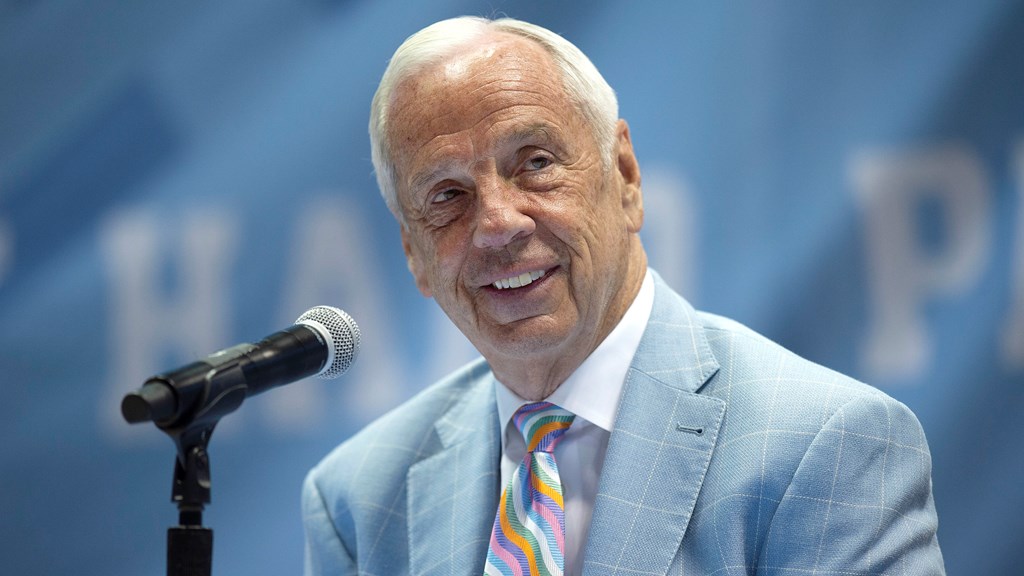
Roy Williams’ sudden retirement Thursday is a reminder that even 900-plus wins and three national championships are not enough to provide invincibility. (Photo by Jeffrey Camarati/Tar Heel Photo)
The announcement Thursday morning was shocking enough in its own right. The words that followed hours later were even more sobering, with the common theme linking them being the sharpest of scissors that tore through the strings of every Carolina blue-colored heart across the land.
No one ever adequately prepares for moments like this. In fairness, though, how can you? What reaction suffices or justifies the abrupt retirement of a Hall of Fame coach with 903 career wins and three national championships, one who arguably saved his alma mater by coming home and lifting the gold standard of college basketball from an unforgivable 8-20 campaign two seasons prior back into the fairytale kingdom his mentor spent 36 years constructing and building upon?
Very few among us would have been able to find exactly the right words to describe Roy Williams’ emotional decision to call it a career after a third of a century split between Kansas and North Carolina, the last 18 years in Chapel Hill, where he not only upheld the legacy of the late great Dean Smith, but accomplished the Herculean task of magnifying and enhancing it while also forging his own in a uniquely distinct fashion.
And when Roy explained his decision, letting nothing get in the way of his rationale, even fewer knew how to process multiple invocations of no longer feeling as though he were the right man for a job that was, by all accounts, destined to be his even after he declined it at first offer in 2000 upon the retirement of Smith’s longtime lieutenant and hand-picked successor, Bill Guthridge.
It will always be sobering whenever one watches someone come to grips with — even warmly accepting — his or her own mortality. In a world and society that rewards those who tap into their fullest potential, it is a harsh and shrill cry to the senses when one acknowledges incapability. Seeing that in Williams, who pushed his 70-year-old body more in recent years than ever between a combination of his recurring battles with vertigo, the pandemic, and the off-the-court uncertainty that lingered around his 2015-16 and 2016-17 teams — the former coming within seconds of a national championship, the latter having earned its redemption — confirms once more that time not only waits for no one, it also remains, and will always be, a flat circle.
If nothing else, Williams being at peace with his decision to walk away from a game and sport that, in light of recent legislation regarding the usage of student-athletes’ name, image and likeness; as well as the much-maligned transfer portal that counts approximately a quarter of the entire complement of Division I players, is a small consolation to the most ardent of Carolina fans who do not have it in them to see their coach struggle to adapt to a landscape he may not be a suitable fit for. Younger Tar Heel fans may now find themselves wondering where the program goes from the only coach many of them have ever known or remembered. I was one of those myself when Smith retired in October 1997, several weeks after my 11th birthday. This is different for many reasons, but even 24 years later, the same question is being asked:
Where do we go from here?
The answer, as it was when Smith passed the reins to Guthridge and will when Williams’ successor — whomever it may be — is announced, remains unchanged:
Forward.
Williams, as has always been the case whether observing from a distance or up close and personal, tackled the elephant in the room head-on. He admitted to being scared of what may lie ahead with the book now closed on one of the most prolific careers in the sport, but at the same time, walks away — in his own words — happy and proud of what he, his players and coaching staff accomplished.
“My teams have taken me to nine Final Fours,” Williams recalled in 2016 after UNC had secured yet another trip to the national semifinals after defeating Indiana and Notre Dame to leave Philadelphia with an East Regional championship, a living, breathing display of the same luck and good fortune he reiterated Thursday in his farewell to a sport and community who is far more fortunate to have had him around than he will ever know.
Through every daggum, tough little nut, frickin’, and every other colorful expression he articulated with an equally charming smile, Roy Williams validated the collective luck of the world to have been in his presence, and we will all realize now that one truly never does know what he or she has until it is gone.
It’s just going to hurt like the dickens when we do.
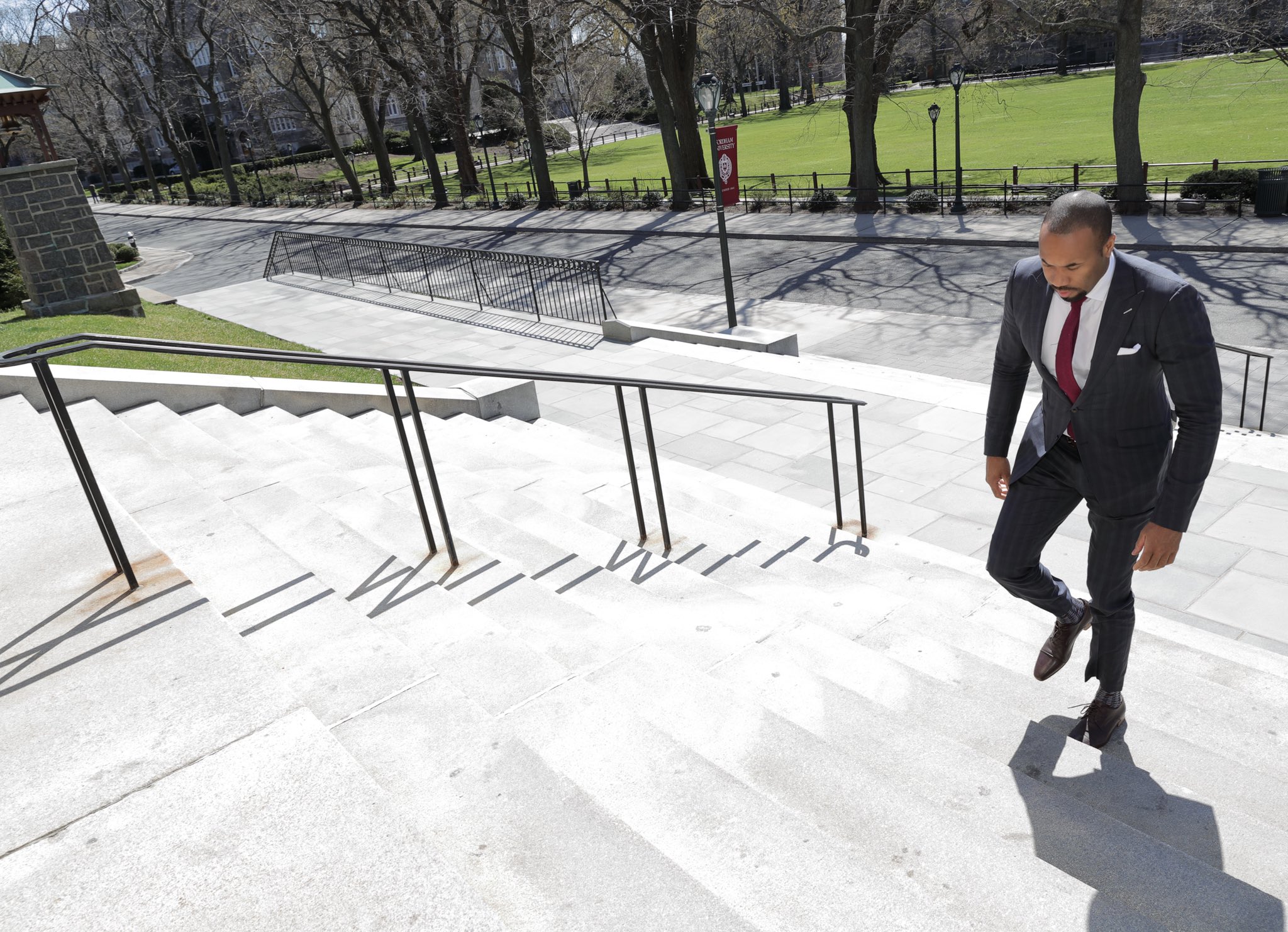
Kyle Neptune ascends steps to Rose Hill Gymnasium, and up the ladder to his first head coaching job after Fordham made his hire official Tuesday. (Photo by Fordham University Athletics)
Fordham greeted its future Tuesday, unveiling Kyle Neptune as the new head coach of the Rams to complete a two-month search process initiated by athletic director Ed Kull and university president Rev. Joseph McShane by bringing the 36-year-old Brooklyn native back to his home city after eight years on the staff of Jay Wright at Villanova, under whom he helped develop the Wildcats into two-time national champions in his stint on the Main Line.
Further insights into how Neptune will mold his program will come as the offseason rolls on, but on the day he was introduced, I was able to take a few minutes to get a feel for what lured him to the Bronx, the type of players and coaches he will target to join him on this endeavor, and what he sees Fordham becoming under his watch:
Jaden Daly: If you can, just take me through the whole process of being a candidate, meeting with Ed, meeting with Father McShane, the administration. What attracted you to Fordham, what convinced you that this was the move after spending 13 years as an assistant, the last eight with Jay?
Kyle Neptune: I’m a New York City guy. I’m from Brooklyn, and I’m passionate about New York City basketball. Growing up, I’ve come to Fordham as a player in grassroots as a teenager, and as a coach coming here to recruit for the catholic school playoffs. I’ve always looked at it as a special place, a place I could possibly end up at, and I’ve always been passionate — always kept an eye on this place — and now being here, it’s very apparent, just meeting a lot of the people here, how special a place this is. So being a New York City guy and the great academics here, I look at this place as a place I could have ended up at as a New York City private school kid. This is one of the schools that I looked at — I guess I wasn’t good enough of a player to get here, as Ed told me earlier — but I’m definitely passionate about Fordham University.
JD: How much has changed in terms of New York basketball since you left on your own to start your coaching career, and now that you’re back, how much better has it become and how much more can you add with your experience to an already evolving talent pool and game here?
KN: I think New York has always been known as the Mecca of basketball, and I think that it’ll always be that place because of the amount of people here, and there’s enormous talent to choose from. I’m planning on using my relationships that I’ve gained from growing up here and then coming back to recruit here to Fordham’s advantage, and I’m excited to kind of reaffirm the relationships that I’ve had over time here. Hopefully they’re as passionate about Fordham basketball as I am.
JD: For those who don’t know you, what goes into a Kyle Neptune player, a Kyle Neptune team, your personal brand of basketball? What can we expect?
KN: I’m just looking for special people. I think that we’re trying to find special people who think a little different and want to achieve special things. I really believe that if you’re willing to do things and create very good habits, you can accomplish great things, and that’s what we’ll be looking to do on the recruiting trails and for our staff as well.
JD: I know it’s too early to speculate on who you would hire for a staff, but what are you looking at in prospective assistants? What kind of qualities would endear you to them to jump on board with you?
KN: For me, I’d like every coach to be a great mentor to our guys, to be a good coach, and be a great ambassador for our university. I think everyone will have a different role in terms of assistant coaches, basketball operations, video coordinator, all those things, but I want those three things to be consistent: Being a mentor to our guys, being a great basketball mind and a great coach, and being a great ambassador to Fordham University.
JD: From watching Villanova over the years, the culture has always been the biggest part of that program. How much of that will you bring with you here to Fordham, and what particularly are you looking to instill?
KN: I think it starts with finding special people who want to be special. I think culture’s a big buzzword that people talk about a lot now, especially in college athletics, but I think that really starts in recruiting and finding people who are willing to do things and go through things that most people aren’t, and are willing to commit themselves at a different level. So it starts there for me, finding special people willing to give of themselves and commit at a different level.
JD: You mentioned you’re looking to get challenged as far as the out-of-conference schedule. What kind of profile do you eventually hope to attract with this school and this program to get it back to the level it once was at?
KN: We want to be the type of program where we’re looked at as the best of the best. I want to compete at the highest levels, I want to compete with anyone in the country, so that’s what’s going to be the goal. At the end of each season, we want to be the best we can possibly be, with the ultimate goal being known as one of the best of the best.
JD: Have you met with any of the current players in the program yet, and if so, how much of their skills translate to the type of system you want to run?
KN: We got a chance to meet with our guys earlier today, we’re going to set up some individual meetings to kind of dive in further and start to build some relationships, and then we’ll get on the court in the next week or so here and start building those relationships and start trying to figure out exactly what we’re going to do on the basketball court moving forward.
JD: Is there a particular style that you’re looking to implement? I know Jay ran the four-out offense.
KN: Yeah. For the four-out, you’re going to need great basketball players, guys who can read and react and make plays, and maybe not running as many sets. To do that, you’ve got to recruit really good basketball players who make good decisions, and that’s definitely something I’m going to do.
JD: As far as Fordham overall being one of the better jobs in the New York area and the reach that the A-10 has, what can this program ultimately become in your eyes?
KN: I think we touched on it before: I want to compete with the best of the best. I think the Atlantic 10 is one of the best conferences in the country, I think the league is going to get better, and I want to compete to be one of the best teams in this league. That’s always going to be the goal.
To know Shaka Smart is to love him, to become like him.
Immerse yourself in his contagious and infectious enthusiasm, let it envelope you in its all-encompassing grip and understand that there is more to life than just basketball, but also that the hardwood contains a philosophical and familial aspect to it that renders Marquette’s new head coach similar to the fan base he now inherits:
Hungry. Thirsty. Boundless.
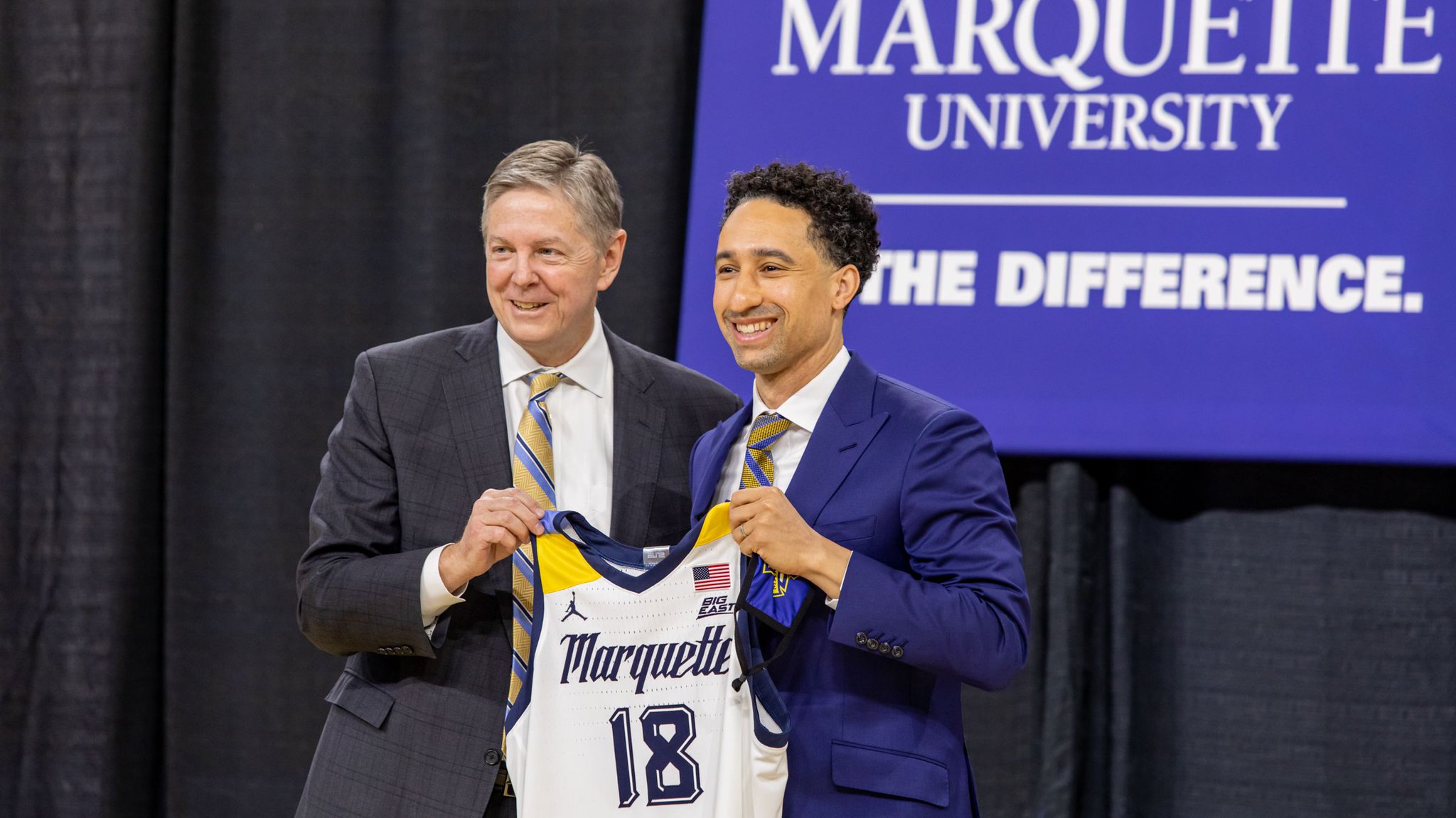
Smart spoke intimately and passionately of the family atmosphere that lured him from the football hotbed of Austin and a lucrative payday at the University of Texas back to his native Wisconsin, and the excitement with which he met it Monday afternoon and pledges to uphold as he connects with the players, the fans, the community.
For that is the true ethos of Shaka, a man who thrives on cultivating and intensifying the relationships he forges with an effervescent smile and unblinking eye contact. There is a reason why Smart remembers someone forever even if he has not spoken to him or her in years, and vice versa. It was that quality that made him so widely revered in his first stop at VCU, and one that made him such an appealing choice to replace the droll and sometimes canned personality of Steve Wojciechowski.
Yet for all of Smart’s gifts and accolades, one stands out in particular, the ability to hype the tenth man in the rotation as much as the leading scorer, the ability to make every young man he is entrusted to lead feel like he matters. When VCU won the Atlantic 10 Conference championship in 2015, Smart made it a point to single out JeQuan Lewis and Doug Brooks — reserve guards who saw minimal minutes in the grand scheme of things, but in the wake of Briante Weber’s torn ACL, crucial cogs in the Ram machine — for their vitality to the program and contributions that belie the final numbers.
So how is it that a coach is able to create such a harmony within the walls of his locker room, where productivity may not matter as much as the positive energy and impact contributed? Smart gave a candid and eye-opening answer.
“That’s a great question, and it has become tougher and tougher,” he said. “I would say 25 years ago, when I was a teenager, it was more, ‘Hey, everybody, do what the coach says,’ and some guys might not like it, but if the coach says it, you went and did it.”
“It’s a different world we live in now. I think social media, the 24-hour news cycle, continuous coverage has changed things, so it’s incredibly important for guys to know and feel like they’re valued members of the team. Now, you only have 200 minutes to dole out in a regulation game.”
And how is it that a man who exudes infinite confidence can do the same with a finite number that shrinks ever so smaller in the heat of battle? Observe this glimpse into the Tao of Shaka:
“One of the exercises I do with my teams is letting the guys go up on the whiteboard and write out how many minutes they would play each guy on the team,” he revealed. “But it can only add up to 200. And it’s interesting, because you talk about games — you mentioned the A-10 championship game — anytime you’re able to do something special, inevitably, there’s a guy that maybe doesn’t have eye-popping numbers, maybe doesn’t start or even play significant minutes most games. But there’s a guy that helps you win, and that’s the unique dynamic we have in basketball.”
That innate eye for the unassuming reserve who affects the game with his intangibles was just as much a characteristic of Smart’s VCU teams as his Havoc defense, which stresses aggressive defense with disruptive pressure and a premium on forcing turnovers to get in transition and fuel the 3-point shot. But it takes a special person to recognize the dichotomy between team success and individual betterment, one Marquette now has well within its grasp, made even sweeter after waiting seven years to turn the words “done deal” from a regional punchline to a promising marriage.
“It is a consummate team game, but in so many ways, it is evaluated and even marketed at times at the highest level by the individual,” Smart cautioned. “And so our job as coaches is to deal with that kind of interplay between team sport and individual evaluation, because let’s face it: Players that are good enough to play at this level, they do have goals — individual goals — even beyond college, and that’s a good thing.”
Shown here cutting net after Villanova won national championship in 2018, Fordham is hopeful that Kyle Neptune can lead Rams to similar fortune after hiring him as head coach. (Photo by VUHoops.com)
Fordham’s last six head coaching searches resulted in five sitting college coaches and a former NBA coach, leading many to question the state of a program mired in a decades-long morass since its most recent NCAA Tournament appearance, back in 1992.
Monday morning saw the Rams try something new to reverse the course of its orbit around the college basketball landscape, turning to a hungry young coach with tremendous upside and a proven championship pedigree.
Kyle Neptune, who spent the past eight seasons on the staff of Jay Wright at Villanova, has reached a deal to become Fordham’s next head coach, replacing Jeff Neubauer — who departed the program in January after a disappointing start to his sixth season at the helm — and interim head coach Mike DePaoli, who guided the Rams to the finish line of a pandemic-marred campaign.
A Brooklyn native, Neptune, 36, gets his first taste of head coaching experience after helping to leas the Wildcats to a pair of national championships, and does so at a program still lauded as one of the best mid-major jobs in the New York metropolitan area, further cementing the Hall of Fame credentials of his mentor Wright, who adds another branch to a fruitful coaching tree that now counts nine head coaches with this latest hire.
Neptune recently completed his second stint on the Main Line, having spent two seasons from 2008-2010 with Wright and the Villanova program following his graduation from Lehigh, where he played for four years and was a team captain as a senior. He then served as an assistant at Niagara from 2010-2013 before following Joe Mihalich to Hofstra for a brief period, only to return to Villanova when Billy Lange left his post on staff for an assistant coach position with the Philadelphia 76ers. Praised as an effective communicator and developer of NBA talent the likes of Ryan Arcidiacono, Saddiq Bey, Mikal Bridges, Jalen Brunson, Donte DiVincenzo, Josh Hart, Darrun Hilliard and Eric Paschall, Neptune now takes the next step in cultivating further professional success stories, this time at a shop of his own.
“Kyle is going to make an excellent head coach at Fordham,” said Quinnipiac head coach Baker Dunleavy, who worked alongside Neptune at Villanova before taking over the Bobcats’ program in 2017. “He combines a tireless work ethic, great knowledge for the game, and most of all, a passion for New York City basketball. I look forward to watching him build a terrific program.”
Neptune had risen to the forefront of Fordham’s coaching search two weeks ago, emerging from a pool of candidates that included Yale head coach James Jones, Saint Peter’s head coach Shaheen Holloway, and Bryant head coach Jared Grasso, who was reportedly the runner-up in the process. Sources had indicated on March 18 that Neptune was the favorite, and that the job was “his if he wanted it,” with Fordham athletic director Ed Kull presumably waiting for Villanova to be eliminated from the NCAA Tournament to make an official announcement. Kevin Sweeney of CBB Central and Sports Illustrated was first to corroborate this report Monday morning, with CBS Sports college basketball insiders Matt Norlander and Jon Rothstein following suit shortly thereafter.
Terms of the contract have yet to be disclosed, and an official announcement from Fordham on Neptune’s arrival is expected later this week. More information will be posted as it becomes available.
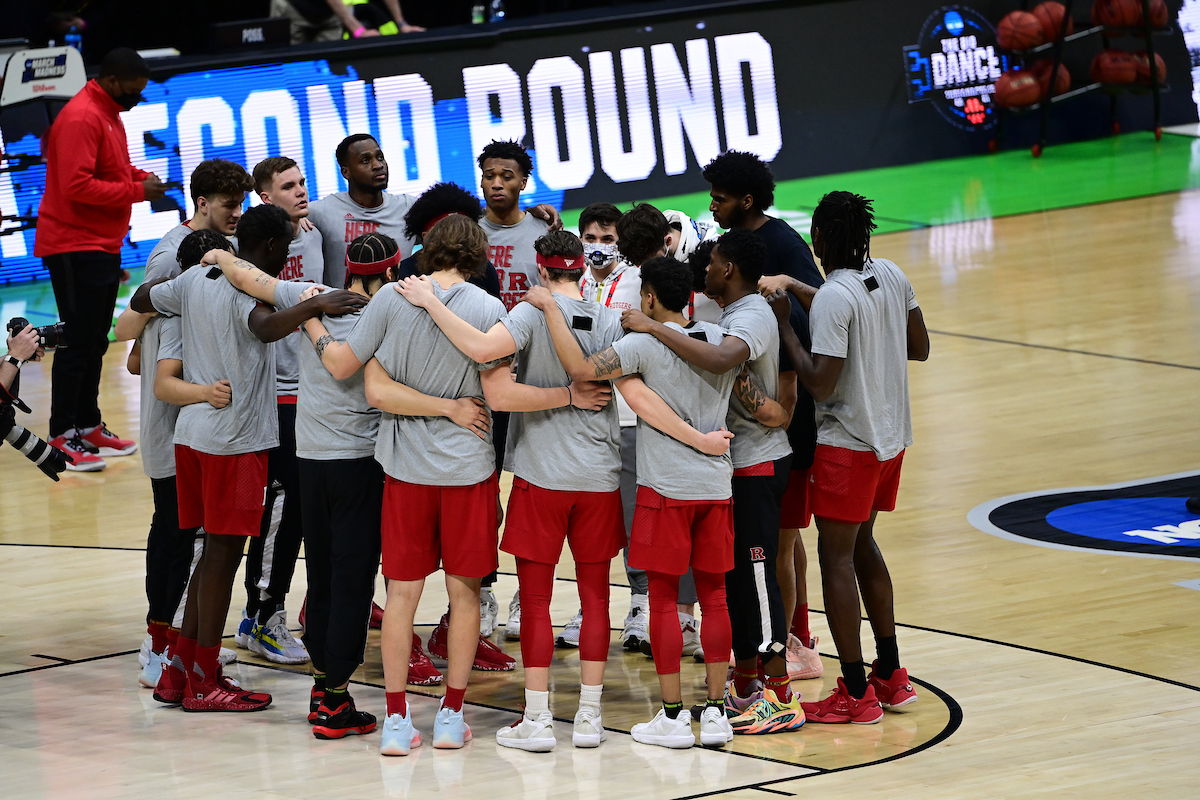
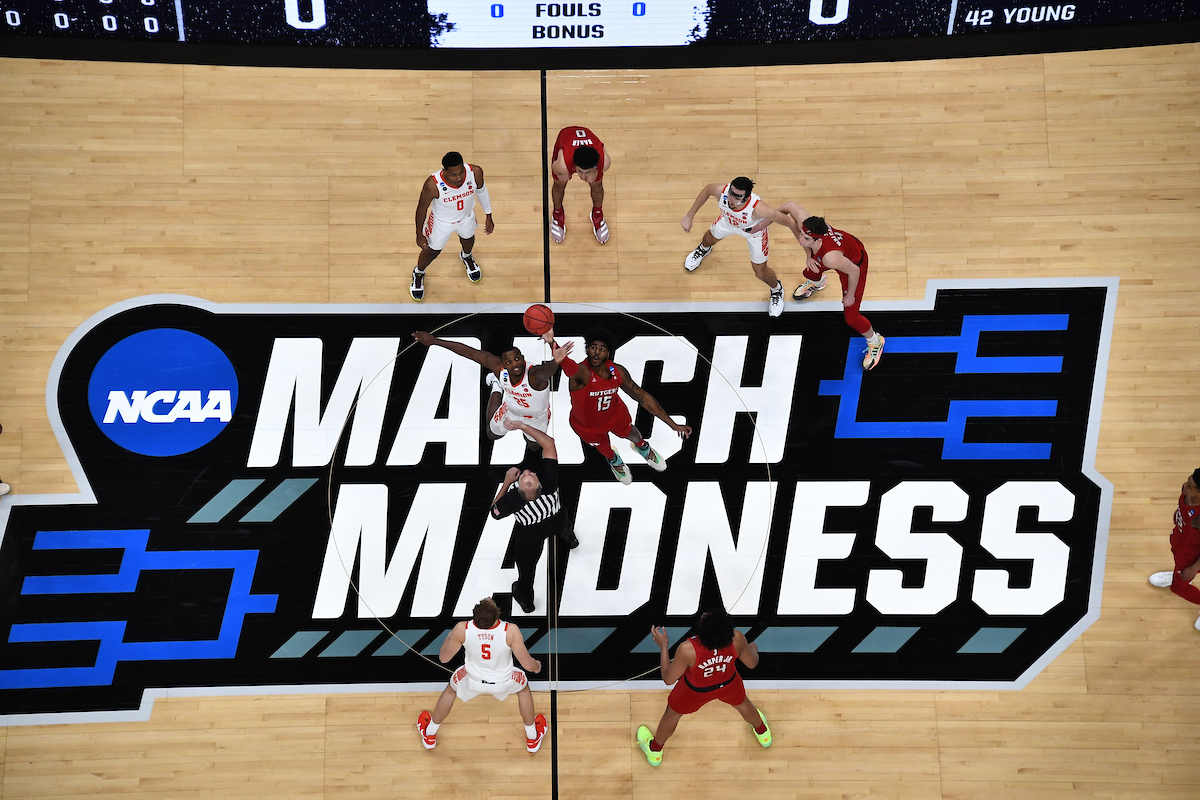
Rutgers’ final game of 2020-21 will show a loss on paper, but program’s defining memory of this season should be that of raising bar in Piscataway for future success. (Photo by Rutgers Athletics)
Rutgers alumnus Jim Valvano said it best when he took Iona on a magic carpet ride just over four decades ago.
Dare to dream.
Years later, with his coaching career having ended and in a fight for his life, the affable and colorful Valvano offered more sage advice.
“Think about it,” he said in his iconic speech at the 1993 ESPY Awards. “If you laugh, you think, and you cry, that’s a full day. That’s a heck of a day. If you do that seven days a week, you’re going to have something special.”
Sunday night, Valvano’s alma mater ran that emotional gamut and then some, leading Houston by eight with just over four minutes remaining and just the program’s third-ever appearance in a regional semifinal awaiting it. But when Myles Johnson’s missed dunk led to a 3-pointer by DeJon Jarreau at the other end, a five-point swing set the wheels in motion for what became a game-ending 14-2 run and a 63-60 victory for the Cougars in what amounted to a double dose of heartbreak for the Scarlet Knights, who learned after the game that beloved radio analyst and former assistant coach Joe Boylan had passed away earlier in the day at the age of 82.
But the fact remains that this Rutgers season should be remembered less for how it ended than for how it began, and the program-changing milestones along the way.
A 6-0 start. A victory over eventual No. 1 NCAA Tournament seed Illinois. Road wins against Maryland and Indiana for the first time in program history. Defeating Michigan State, a perennial Big Ten heavyweight, for the first time and holding the Spartans to just 37 points in the process. The maturation of Geo Baker, Myles Johnson and Jacob Young into three senior bedrocks and standards for which Rutgers should come to expect from its upperclassmen. The emergence of Ron Harper, Jr. as the flag-bearer for the next iteration of Scarlet Knights. The upside of Montez Mathis, Caleb McConnell and Paul Mulcahy. The potential of Cliff Omoruyi after leading a four-pronged freshman class into their baptism to college basketball.
All those accomplishments outweigh the agony of a three-point loss and a handful of unlucky bounces.
“We need this group to be remembered for a long time,” a visibly dejected Steve Pikiell, no stranger to the cruel realities of March anguish from his four near-misses at Stony Brook before finally breaking through in 2016, concurred. “I’m just sad for us. I never wanted to put these uniforms away. This group has been awesome. Whenever we got knocked down, this group always got back up.”
“This team made history. They got through a two-year journey — COVID, never missing a day, never having a pause — all the obstacles they had to fight through. They now become the standard for what we want to be at Rutgers.”
So much has been made over the years of Rutgers — before Pikiell arrived in Piscataway five years ago today — having never been able to punch above its weight class, to survive a heavyweight fight with its dignity not shattered, its overall reputation enhanced. In winning its first NCAA Tournament contest since 1983, the colors on the mural that is Rutgers basketball became ever more vibrant, richer and more symbolic. Baker proved that in a poignant postgame press conference, noting that while he blames himself for his turnover in the final minutes as Rutgers looked to steal a victory, a moment like that only lays the groundwork for a comeback.
“Losses are lessons,” the senior point guard reflected in what could be the coda to a four-year career that will be forever remembered on the banks for a belief in something bigger and a litany of step-back jumpers emulated by thousands of fans young and old. “This is probably just going to be another one of those.”
“How do you take it in? How do you react to it? How do you bounce back and make something positive out of it? But there are better days ahead. You just have to understand that and work through it, just continue on.”
Rutgers will do that now, possibly without Baker, most likely without Young, who hinted on social media in a thank-you post that is likely taking the next step. The core of the team should return largely intact, and in prime position to make this season one that harkens back to Pikiell’s own senior year at UConn in 1990, when the Huskies reached an improbable regional final:







/cdn.vox-cdn.com/uploads/chorus_image/image/63198027/941210992.jpg.0.jpg.cf.jpg)